Over the past few years, handheld gaming has split into two very different directions. On one side are powerful Windows-based devices such as the
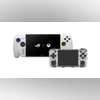
Asus ROG Ally, the ROG Xbox Ally, MSI Claw and similar machines that are essentially compact PCs with controllers attached. On the other are smaller, cheaper retro handhelds such as the Anbernic RG35XX H, built mainly around emulation and older console libraries.
Having spent time with both types, including the ROG Ally, ROG Xbox Ally, Nintendo Switch, and retro handhelds like the Anbernic RG35XX H and MIYOO Mini Plus, I’ve come to think that retro emulation handhelds, despite their limitations, often fit the idea of a “handheld console” better than most modern flagship handhelds.
That does not mean the newer, more powerful devices do not have a use case. In many ways, they are more capable. But capability and suitability for handheld gaming are not always the same thing.
Why retro handheld emulators fit better as handheld consoles
The biggest difference shows up the moment you pick these devices up. Retro handhelds are smaller, lighter, and built around much simpler hardware. Because they are designed to run older games — from systems like the NES, Game Boy, PSP, PS Vita, N64, PS1 and in some cases even PS2 — they do not need large cooling systems, high-wattage chips, or bulky batteries. The result is a device that is easier to carry, more comfortable to hold for longer sessions, and generally less prone to getting hot in your hands.
Most of these devices also run simple, usually Linux-based operating systems. That keeps the experience focused. You turn the device on, pick a game, and start playing. There is very little of the overhead that comes with a full desktop operating system. At the same time, these systems are highly customisable: you can change menus, themes, layouts, and even how the emulators behave. You can shape the device around how you want to play.
There is also a software fit that often gets overlooked. A large part of the library these devices support was originally designed for handheld or low-power consoles in the first place. Games from the PSP, Game Boy, or older consoles were built around shorter play sessions, simpler controls, and smaller screens. They tend to scale down well, both visually and in terms of how they feel to play on a portable device.
Cost plays a role too. Because the hardware requirements are lower and the games themselves are older, retro handhelds are far cheaper. You are not paying for the ability to run modern PC games; you are paying for a focused, portable way to access a large back catalogue. For a device that is meant to be used on the go or as a secondary gaming machine, that trade-off makes sense.
Some newer retro handhelds also run Android, which opens the door to mobile games that are already designed around touch screens, short sessions, and portable use. In practice, those games often feel more natural on a handheld than many PC or console titles that have simply been scaled down to fit a smaller screen.
What modern handheld consoles do better
Devices like the ROG Ally or the ROG Xbox Ally are impressive for a different reason: they are extremely versatile. They can run modern PC games, handle demanding emulation, support cloud streaming, and function as small Windows computers. If your goal is to play the latest PC releases on a portable device, a retro handheld simply cannot compete.
There is also a clear advantage in ecosystem integration. With something like the ROG Xbox Ally, you can start a game on your Xbox console, continue it on the handheld using the same save file, and then switch to a PC without losing progress. That kind of continuity is genuinely useful and fits well with how many people already play games across devices.
Screens on these flagship handhelds are usually better too — higher resolution, higher refresh rates, and generally brighter and sharper panels. For modern games, that makes a visible difference.
But all of this comes with trade-offs. To deliver that performance, these devices need more powerful chips, more cooling, and bigger batteries. That makes them heavier, bulkier, more expensive, and more prone to heat and battery drain. On top of that, they run Windows, which is not really designed around handheld use. Even with custom launchers and tweaks, it still feels like a desktop operating system squeezed into a portable form factor.
There is also a software mismatch at times. Many modern PC and console games are designed for large screens, long sessions, and keyboard or full-size controller setups. They can run on a handheld, but they are not always comfortable to play that way.
Who should choose what
In practice, most handheld gaming devices — even the flagship ones — are still positioned as secondary gaming machines rather than primary consoles. They are meant for travel, short sessions, or playing away from a desk or TV.
If what you want is a focused, affordable, and comfortable portable device for older games, emulation, and even some Android titles, retro handhelds make a lot of sense. They are easier to carry, simpler to use, cheaper to buy, and better aligned with the kinds of games they are meant to run.
If, on the other hand, you want a device that can slot into your existing PC or Xbox gaming setup, run modern games, and let you carry your saves with you, then something like the ROG Ally or ROG Xbox Ally does things a retro handheld simply cannot. You pay more, and you accept the size, weight, and battery compromises, but you get access to a much broader and more current library.
The Nintendo Switch sits somewhere in between. Nintendo has years of experience building handheld consoles, and it has a library of games that are designed with portable play in mind. That shows in how smoothly the hardware and software work together, and in how well the system shifts between handheld and TV use.
After using both ends of the spectrum, though, the main difference is this: retro handhelds feel like devices built specifically for handheld gaming, while most modern Windows-based handhelds feel like powerful PCs that happen to be portable. Both have their place, but for pure, everyday handheld use, the simpler machines often get the basics right more consistently.

 "Why retro emulation handhelds often make better gaming consoles on the go")


 Connect with us on WhatsApp