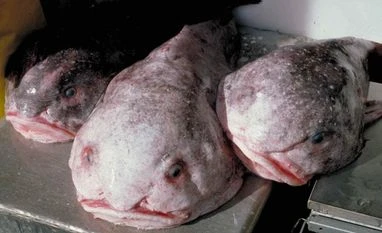
Once leveled as the ‘world’s ugliest animal’, the blobfish has swum its way into the spotlight for a more flattering reason – it’s just been crowned New Zealand’s Fish of the Year, reported The Guardian.
The gelatinous, famously glum-looking blobfish, Psychrolutes marcidus, inhabits the deep, pressurised waters off the coasts of New Zealand and Australia. Adapted to a world far beneath the surface, blobfish have evolved in remarkable ways. They lack many features typical of other fish: no swim bladder, no full skeleton, no muscles, and no scales. Instead, their bodies are mostly made of soft, squishy tissue with a lower density than water, allowing them to hover effortlessly just above the ocean floor.
According to Konrad Kurta, spokesperson for the Mountains to Sea Conservation Trust, which runs the annual competition, blobfish can live up to 130 years and are both slow-growing and slow-moving.
“It sort of sits there and waits for prey to come very close and practically walk into its mouth before it eats them,” said Kurta.
Surprisingly, the blobfish is also a committed parent. Females lay up to 100,000 eggs in a single nest, which they guard diligently until hatching.
The blobfish first rose to fame more than a decade ago when a crew member aboard a New Zealand research vessel snapped a photo of the rarely seen creature. Its unusual, droopy appearance quickly went viral, becoming a staple of internet memes. However, Kurta points out that its out-of-water look is misleading.
“Regrettably, when it is pulled up … that sudden decompression causes it to become all disfigured,” he explained, noting that underwater, its shape is more typical of a bulbous deep-sea fish. Out of its natural habitat, it can resemble “a failed medical experiment,” he said, speaking to The Guardian.
Blobfish at risk from trawling
Despite its popularity, little is known about the blobfish’s conservation status, largely due to limited research. However, its deep-sea environment is under threat. Blobfish are often unintentionally caught during bottom-trawling for orange roughy, a practice known to damage fragile marine ecosystems.
“Blobfish are fairly frequently pulled up from the bottom-trawling of orange roughy,” Kurta said.
The Fish of the Year competition, launched in 2020 and inspired by the successful Bird of the Year, aims to raise awareness of New Zealand’s native aquatic life. This year saw a record 5,583 votes, a massive jump from just over 1,000 the previous year.
Blobfish triumphs in close contest
The blobfish secured victory with 1,286 votes, edging out the orange roughy by around 300 votes, despite the latter enjoying endorsements from heavyweights like Greenpeace, Forest & Bird, and the Environmental Law Initiative.
“We are very pleased for the blobfish,” said Aaron Packard of the Environmental Law Initiative. “From an ecosystem perspective, a win for blobfish is a win for orange roughy.”
New Zealand is responsible for about 80 per cent of the global orange roughy catch, and environmental groups frequently call for restrictions on the practice due to the damage it causes to deep-sea ecosystems and the vulnerability of fish populations.
New Zealand’s aquatic diversity
Other contenders in this year’s competition included the longfin eel (known as tuna in Maori), a pygmy pipehorse, a critically endangered mudfish, as well as various sharks and rays.
Kurta emphasised the country’s rich diversity of aquatic species, noting that 85 per cent of native marine and freshwater fish are considered vulnerable. “That [these fish] exist is often the first step to getting people invested and interested in what’s happening below the waterline,” he said.

 "From world's ugliest to 'Fish of the Year': Blobfish makes a splash in NZ")


