Home / World News / Here's why Elon Musk has bigger problems in land 'Tesla takedown' forgot
Here's why Elon Musk has bigger problems in land 'Tesla takedown' forgot
The billionaire's tarnished image is showing signs of damaging his company across the world. After he backed the far-right Alternative for Germany party, sales in that country last month slumped 76%
Imagine a land where the bad publicity emerging from Elon Musk’s current sabbatical as a constitution-shredding, extremism-promoting consigliere to President Donald Trump wasn’t tarnishing the image of Tesla Inc.
Believe it or not, such a place exists — and it’s Tesla’s second biggest market, China. That might not be enough to save Musk from the global backlash engulfing his company.
The billionaire’s tarnished image is showing clear signs of damaging his company across the world, as my colleague Liam Denning has written. After he backed the far-right Alternative for Germany party, sales in that country last month slumped a brutal 76 per cent. California, which hasn’t reported 2025 sales numbers yet, also looks fragile.
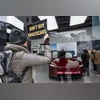
Then there’s the #teslatakedown movement, an online backlash. A US site for demonstrators lists 72 separate protests against Tesla showrooms, superchargers and other facilities on the weekend of March 8-9 alone. Elsewhere, cars and chargers have been vandalised. Singer Sheryl Crow sold hers and donated the proceeds to public broadcaster NPR. A red Model Y that parks on my block in a left-leaning enclave of Sydney, Australia has taken to adding a bumper-sticker reading “NOT AN ENDORSEMENT.”
It’s hardly surprising that such activism is mostly absent in China. Protests against authoritarian leaders are a cherished and lively tradition in most democracies. In a country where even Peppa Pig videos can be considered dangerously subversive, people are more inclined to keep their heads down.
It goes further than that, though. The Musk brand seems to be authentically popular in China. Elon’s mother, model and dietician Maye Musk, is a huge star on local social media with nearly 700,000 followers on Xiaohongshu, a video-sharing platform where she posts regular updates promoting her memoir, wearing qipao dresses, collaborating with Chinese brands and offering Lunar New Year wishes. At New York Fashion Week last month, the 76-year-old walked down the catwalk wearing an outfit by Taoray Wang, a Chinese designer popular in Trump world.
The symbolism of an innovative tech executive cozying up to authoritarian leaders is also quite different in China. Signs of President Xi Jinping ending a thaw in the four-year freeze-out of Alibaba Group Co. founder Jack Ma last month caused a brief rally in stock prices, and hopes of less heavy-handed government control.
Musk’s remarkable ability to hold his notoriously undisciplined tongue in matters relating to the Communist Party of China — repeating the official line on issues such as Taiwan, and breaking the Washington consensus on decoupling the US and Chinese economies — has also won him plenty of high-level friends in Beijing. Just last month, Tesla inaugurated a new battery plant in Shanghai to join its car lines in the same city.
The larger share of EVs in Chinese car sales probably helps matters, too. In the US, where more than 90 per cent of automobiles still have engines, the key market for battery vehicles is among left-leaning types who take a dim view of Musk’s far-right politics. In China, where 45 per cent of sales last year came with a plug, EVs have penetrated far deeper into the mainstream where people don’t use their car purchases to express political viewpoints.
That shouldn’t be a comfort. Indeed, it’s the greater dominance of EVs in China that represents Musk’s far bigger risk — and helps explain his local problem, where shipments fell 49 per cent in February. In the US, about 44 per cent of EV sales last year were Teslas. Even in the European Union where Tesla had just 11 per cent of the EV business, it was comfortably the leading brand.
Things are very different in China, where Musk’s business took just 5.7 per cent of the plug-in vehicle market last year and was only the fifth-biggest seller. In the fourth quarter, BYD Co. sold six vehicles in China for every one chalked up by Tesla.
In China’s burgeoning EV market, there’s such an abundance of innovative, affordable local marques that Tesla’s Model Y — still leading the market ahead of BYD’s Seagull, just — is simply looking tired and old. Visiting Guangzhou over the Lunar New Year last month, it was hard to spend time at a shopping center without finding shiny test cars from Li Auto Inc., NIO Inc., Xiaomi Corp., and Xpeng Inc. being tried out by curious local buyers. I didn’t see a Tesla showroom, and none of the dozen or so electric taxis I caught in China over the past nine months were made by the company.
That ultimately may be a far greater long-term risk. In the rest of the world, Tesla is a decent car brand being dragged down by the repugnant actions of its boss. In China, the Musk family’s star power is one of the few things burnishing his company’s pretty ho-hum image, as the likes of BYD roll out free driver-assistance technology that Tesla wants you to pay for.
Should #teslatakedown leaders succeed in their campaign to drive the world’s richest man from his positions of power and influence, the company that remains will still be a formidable competitor in the US and Europe. In China, however, the pace of the EV revolution has already left Tesla in the dust.
Disclaimer: This is a Bloomberg Opinion piece, and these are the personal opinions of the writer. They do not reflect the views of www.business-standard.com or the Business Standard newspaper

 "Here's why Elon Musk has bigger problems in land 'Tesla takedown' forgot")


 Connect with us on WhatsApp