
Macron touts 'positive new' Asia-Europe alliance amid US-China rivalry
Macron said that the unpredictability of Trump's tariff approach that ended a rule-based order for our trade constitutes a common threat to Europe and Asia
 "Macron touts 'positive new' Asia-Europe alliance amid US-China rivalry")
Explore Business Standard
Macron said that the unpredictability of Trump's tariff approach that ended a rule-based order for our trade constitutes a common threat to Europe and Asia
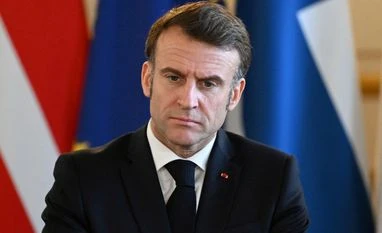
French President Emmanuel Macron has called on European and Asian nations to work together to build a "positive new alliance" to avoid being dragged into the growing rivalry between the US and China.
Addressing the Shangri-La Dialogue in Singapore, Macron singled out the China-US rivalry as the biggest risk confronting the world.
France's longstanding goal for Europe's strategic autonomy is also relevant for Asian countries, which share many of the same interests and can combine forces with like-minded European partners as they seek a third way, Macron said in the speech on Friday.
The time for non-alignment has undoubtedly passed, but the time for coalitions of action has come and requires that countries capable of acting together give themselves every means to do so, Macron said in his keynote address.
Let's build a positive new alliance between Europe and Asia, based on our common norms, on our common principles. Our shared responsibility is to ensure with others that our countries are not collateral victims of the imbalances linked to the choices made by the superpowers, the leader of Europe's second-largest economy added.
We have a challenge of revisionist countries that want to impose under the name of spheres of influence in reality, spheres of coercion; countries that want to control areas from the fringe of Europe to the archipelagos in the South China Sea, at the exclusion of regional partners, oblivious to international law, Macron said.
Macron pointed out that France is an Indo-Pacific nation as seven of its offshore territories sit in the Indian Ocean and the South Pacific, with a million French citizens living in this region.
Macron said that the unpredictability of Trump's tariff approach that ended a rule-based order for our trade constitutes a common threat to Europe and Asia, affecting these nations' ability to finance their defence, requiring their greater cohesion.
France is a friend and an ally of the United States, and is a friendand we do cooperate if sometimes we disagree and competewith China, he said.
We don't want to be instructed on a daily basis what is allowed, what is not allowed, and how our life will change because of the decision of a single person.
The dialogue also included US Defense Secretary Pete Hegseth and defence and security leaders from around the world.
Hegseth, meanwhile, asked Asian countries to increase their defence spending to match levels that Washington expects of European allies.
It is hard to believe I can say this but Asian allies and partners should look to countries in Europe as a new-found example. NATO members are pledging to spend 5 per cent of their GDP on defence, even Germany, he said.
Hegseth had communicated to European allies this expectation at the Munich Security Conference in February.
How can it make sense for countries in Europe to do that while key allies and partners in Asia spend far less in the face of a far more formidable threat from Communist China, not to mention North Korea? he asked.
The global forum is being skipped by China by not sending its Defence Minister.
Defence experts and diplomatic sources said the absence of a Chinese Ministerial representation at the Singapore Dialogue is being felt as China had last year and on several other occasions traded strong words with the US delegates.
Hegseth underlined, Ultimately, a strong, resolute, and capable network of allies and partners is our key strategic advantage. China envies what we have together.
President Donald Trump has been calling on US allies to bear a greater responsibility for their conventional defences, telling the nations in the South China region not to expect the US to bear the financial burden alone for regional stability and security.
For a generation, the US ignored the Indo-Pacific, but under the Trump administration, we are here to stay, Hegseth said.
(Only the headline and picture of this report may have been reworked by the Business Standard staff; the rest of the content is auto-generated from a syndicated feed.)
First Published: May 31 2025 | 11:47 AM IST


