
Musk's budget crusade may cause constitutional clash in Trump's 2nd term
Musk and Ramaswamy said they would encourage Trump to make cuts by refusing to spend money allocated by Congress
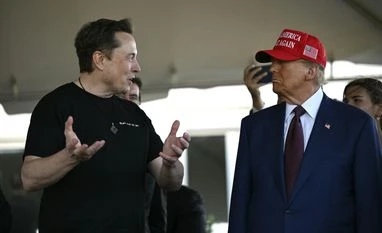 "Musk's budget crusade may cause constitutional clash in Trump's 2nd term")
WebinarsNew
Deep DiveNew
Explore Business Standard
Musk and Ramaswamy said they would encourage Trump to make cuts by refusing to spend money allocated by Congress
When Elon Musk first suggested a new effort to cut the size of government, Donald Trump didn't seem to take it seriously. His eventual name for the idea sounded like a joke too. It would be called the Department of Government Efficiency, or DOGE, a reference to an online meme featuring a surprised-looking dog from Japan.
But now that Trump has won the election, Musk's fantasy is becoming reality, with the potential to spark a constitutional clash over the balance of power in Washington.
Trump put Musk, the world's richest man, and Vivek Ramaswamy, an entrepreneur and former Republican presidential candidate, in charge of the new department, which is really an outside advisory committee that will work with people inside the government to reduce spending and regulations.
This week, Musk and Ramaswamy said they would encourage Trump to make cuts by refusing to spend money allocated by Congress, a process known as impounding. The proposal goes against a 1974 law intended to prevent future presidents from following in the footsteps of Richard Nixon, who held back funding that he didn't like.
We are prepared for the onslaught from entrenched interests in Washington," Musk and Ramaswamy wrote in an opinion piece in The Wall Street Journal. We expect to prevail. Now is the moment for decisive action." Trump has already suggested taking such a big step, saying last year that he would use the president's long-recognised impoundment power to squeeze the bloated federal bureaucracy for massive savings.
It would be a dramatic attempt to expand his powers, when he already will have the benefit of a sympathetic Republican-controlled Congress and a conservative-majority US Supreme Court, and it could swiftly become one of the most closely watched legal fights of his second administration.
He might get away with it," said William Galston, a senior fellow in governance studies at the Brookings Institution, a Washington-based think tank. Congress' power of the purse will turn into an advisory opinion.
(Only the headline and picture of this report may have been reworked by the Business Standard staff; the rest of the content is auto-generated from a syndicated feed.)
First Published: Nov 22 2024 | 6:57 AM IST

