Home / World News / Pakistan's power play: Saying yes to all in a risky multipolar world
Pakistan's power play: Saying yes to all in a risky multipolar world
Islamabad might have failed for decades to create the sort of productive, dynamic economy that builds anything the world might want to buy. But that doesn't mean there's nothing left to sell
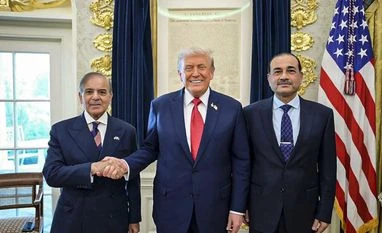
US President Donald Trump during a meeting with Pakistan Prime Minister Shehbaz Sharif and Field Marshal Asim Munir at the White House, in Washington, DC, USA. (Photo: PTI)
Pakistan’s leaders have worked out how to manage two rival superpowers in a way that seems to have escaped much more stable nations. They’re promising the US a foothold in the economy that doesn’t step on China’s — and vice versa. Their response to a multipolar world is to give every pole a stake.
In the past months, the nation’s vulnerability has been starkly visible. Monsoon floods damaged half the crops, killed a thousand people, and displaced millions. The government is still trying to persuade the International Monetary Fund to release $1.2 billion it needs to stay solvent.
And yet its leaders are managing to win friends and influence people. Last month, Prime Minister Shehbaz Sharif visited Beijing and announced $8.5 billion of new investment. More recently, a mutual defence agreement with Saudi Arabia that might extend Pakistan’s nuclear umbrella was signed.
Impressively, Islamabad is managing all this even while locking in gains with the US. Its dependence on China and renewed intimacy with the Saudis haven’t put off Washington — quite the opposite, in fact. President Donald Trump has hosted the military chief, Field Marshal Asim Munir, twice in recent months.
How has the Pakistani establishment — run essentially by Munir and his soldiers, without whom Sharif could not stay in office — managed this? Partly though skilfully re-assessing what a multipolar world actually looks like, and by putting together bespoke offers for possible partners that look too good to refuse.
The US, for example, has reportedly been presented with a port to develop in the southwestern province of Balochistan — possibly as a route to the mineral resources in the interior that Islamabad has already promised the White House.
The offer is a physical manifestation of Pakistan’s developing “please-everybody” strategy. The fishing village in question, Pasni, is 110 kilometers (70 miles) from the Chinese-run port of Gwadar, the southern terminus of Beijing’s ambitious corridor from the Arabian Sea to Xinjiang. If, as official sources have confirmed, Pasni is to play “a vital role in transporting Pakistani minerals to partner countries,” then it appears that Munir and Sharif imagine two parallel tracks bisecting their country, one built for China and one serving the West.
There’s real money in play, as well. Missouri-based US Strategic Metals has signed a $500-million contract with an army-run company, the Frontier Works Organization. The Asian Development Bank has created a $410 million financing package for Barrick Mining Corp.’s Reko Diq mine, which is close to the Iranian border and 400 kilometers (250 miles) north of Pasni. The International Finance Corporation, a multilateral agency, will add another $400 million to try and develop one of the world’s largest remaining reserves of copper and gold.
Even if there is gold in Balochistan, getting it out of the ground isn’t the only challenge. Transporting it to the coast is harder. This is an inhospitable part of the world, as every outsider since Alexander has discovered. (The conqueror’s most difficult days were near Pasni, where the Greeks suffered from “intolerable heat and the lack of food, water and firewood,” and lost most of his army’s families and transport animals to a flash flood.)
The Baloch have always been restive under Islamabad’s yoke, and have killed almost 100 Chinese expatriates in recent years. If the US truly intends to put down roots, it will have to deal with local opposition. Officials may already be preparing for this: In August, the State Department added the Balochistan Liberation Army to its list of foreign terrorist organisations, something of a reversal from how Washington viewed the area a decade ago.
Islamabad might have failed for decades to create the sort of productive, dynamic economy that builds anything the world might want to buy. But that doesn’t mean there’s nothing left to sell. You can still slice off your sovereignty: Outsource fiscal policy to the IMF, share your nuclear umbrella with the Saudis, mortgage your energy infrastructure to the Chinese, and promise the Americans minerals that are still in the ground.
This strategy may have bought the Pakistani establishment another few years. Munir and Sharif must not waste it. They will need to ensure the promised money gets spent, and the hoped-for rewards materialise. And they must use both the treasure and time they have deftly unearthed to stabilise the country’s creaking economy.
(Disclaimer: This is a Bloomberg Opinion piece, and these are the personal opinions of the writer. They do not reflect the views of www.business-standard.com or the Business Standard newspaper)

 "Pakistan's power play: Saying yes to all in a risky multipolar world")


