
Quad transformed from security dialogue into multifaceted tie-up: Report
The new report titled 'Quad: Diplomacy and Cooperation in the Indo-Pacific' assesses the Quad's achievements and potential amidst the ongoing geopolitical churn
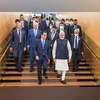 "Quad transformed from security dialogue into multifaceted tie-up: Report")
WebinarsNew
Deep DiveNew
Explore Business Standard
The new report titled 'Quad: Diplomacy and Cooperation in the Indo-Pacific' assesses the Quad's achievements and potential amidst the ongoing geopolitical churn
Moving beyond traditional security concerns, the Quad has transformed from a budding security dialogue into a multifaceted partnership with far-reaching goals through the creation of six leader-level working groups, a report by Observer Research Foundation, (ORF) and East-West Center, Washington DC stated.
The new report titled 'Quad: Diplomacy and Cooperation in the Indo-Pacific' assesses the Quad's achievements and potential amidst the ongoing geopolitical churn, increasing bilateral and multilateral cooperation among member countries, and the need for diversifying channels of collaboration, given the growing regional and global responsibilities.
Quad is a diplomatic partnership between Australia, India, Japan, and the United States committed to supporting an open, stable and prosperous Indo-Pacific that is inclusive and resilient, according to Australia's Department of Foreign Affairs and Trade.
Since regrouping in 2017, the Quad has announced the creation of six working groups that focus on a variety of policies and initiatives.
During the inaugural Leaders' Summit held virtually in March 2021, the group announced a Quad Vaccine Partnership--later renamed the Quad Health Security Partnership--alongside the establishment of a Critical and Emerging Technologies Working Group and a Climate Working Group.
A Space Working Group was established later that year during the first in-person Leaders' Summit held in Washington, DC.
Satu Limaye, Vice President of East-West Center and the Director of East-West Center Washington, who is also one of the report's authors, pointed out some key issues for the Quad to address going forward.
"To what extent should the Quad be securitised? Next is the institutionalisation of Quad - how formal should it be and how does that affect its functioning? Third is operationalising, i.e. delivering. We have a great agenda, but the question is sustainability and delivery of public goods," he said.
Limaye also noted, "(It is important to consider)...integrating the Quad with other institutions that are rising - Partners in the Blue Pacific, Indian Ocean organisations and other kinds of proliferating multilateralism in the region in this very contested and fragmented international system. Finally, how can we coordinate with regional countries and institutions on public goods delivery?"
Reflecting on the future potential of the Quad, the report forecasts that the partnership's six working groups will address a diverse array of challenges and opportunities in the Indo-Pacific.
These range from preparing the region for challenges posed by China to ensuring that intra-regional processes adhere to principles of free, open, inclusive, and responsible conduct.
As the Quad continues to expand and institutionalise its cooperation, its primary imperative is to promote strategic balance while sustainably responding to demand signals from the region.
The Quad Counterterrorism Working Group's focus on an adaptive approach, encompassing technological cooperation and regional partnerships, highlights the commitment of the Quad countries to address the multifaceted nature of the terrorism challenge in the Indo-Pacific region.
Committed to dialogue, cooperation, and collaboration, the Quad aims to tackle shared security challenges, foster economic prosperity, and uphold the principles of a free and open Indo-Pacific, the report added.
As the Quad progresses and broadens its agenda, the report says, it will continue to be a crucial pillar of regional security and stability.
A foundational initiative of the Quad, Humanitarian Assistance and Disaster Relief (HADR) remains a core element of Quad cooperation. With the Quad's renewed focus on providing public goods in the Indo-Pacific, HADR has become a key mechanism given the Indo-Pacific is the most disaster-prone region in the world.
Harsh V Pant, Vice President, Studies and Foreign Policy at ORF and one of the report's authors said, "The Quad has emerged as a crucial platform for fostering regional stability and economic growth. Its current role involves addressing pressing challenges such as maritime security, cyber threats, and climate change while promoting a free, open, and inclusive Indo-Pacific."
He added, "Looking ahead, the Quad's roadmap focuses on enhancing cooperation through its six working groups, which tackle issues ranging from countering China's influence to ensuring adherence to international norms and principles. This strategic collaboration aims to strengthen regional resilience and uphold a rules-based order."
The report concludes that while the Quad is neither a military alliance nor a mutual defence agreement, maritime security cooperation is central to the partnership's mission of supporting free and open Indo-Pacific region.
First Published: Jun 16 2024 | 9:26 AM IST


 Connect with us on WhatsApp