Home / World News / Seoul is facing a more brazen North Korea amid rising border tensions
Seoul is facing a more brazen North Korea amid rising border tensions
South Korea's new president is under pressure to act. In the last 12 months there have been repeated border breaches by North Korean troops, which have at times drawn warning shots from the South
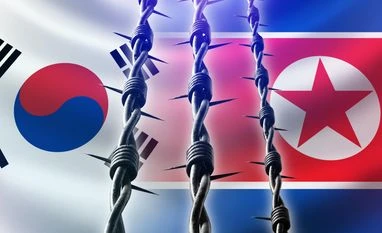
The two Koreas remain technically at war. Image: Shutterstock
5 min read Last Updated : Nov 24 2025 | 8:06 AM IST
By Karishma Vaswani
It’s one of the most heavily armed borders on earth, where a single miscalculation could ignite a conflict and draw in the US and China, among others. The Demilitarized Zone separating the two Koreas — the autocratic North from the democratic South — is always tense. But over the past year, frictions have spiked.
Seoul’s offer last week to hold talks with Pyongyang over the tensions, while well-intentioned, is flawed. Dialogue with Kim Jong Un’s regime rarely works as intended. Kim isn’t after reconciliation; he wants regime survival, and his confidence is growing.
South Korea’s new president, Lee Jae Myung, is under pressure to act. In the last 12 months there have been repeated border breaches by North Korean troops, which have at times drawn warning shots from the South, and Pyongyang conducted a ballistic missile test earlier this month.
The two Koreas remain technically at war. There was no formal treaty ending the 1950-53 Korean War, meaning the two have in theory been in conflict for more than seven decades. Unification under the North’s leadership has been central to Pyongyang’s ideology, despite being an increasingly unrealistic goal. Last year, Kim made the break explicit, branding the South a hostile state for the first time.
This shift is telling, and marks Pyongyang’s new self-assurance, as my colleague Andreas Kluth has noted. Pyongyang today is not the isolated pariah Lee’s predecessors faced.
Kim has forged a mutual-defense treaty with Russia, formalizing military and intelligence cooperation. He’s sent troops to fight alongside Russian forces against Ukraine, and deepened ties with main trading partner China. The image of Kim flanked by Vladimir Putin and Xi Jinping at a military parade in Beijing in September sent a calculated message: This is an emerging anti-Western axis in Northeast Asia.
These partnerships blunt the sting of sanctions, reducing incentives for the North Korean leader to dial back his military ambitions. Pyongyang is estimated to have around 50 warheads, with some thought to be capable of reaching the continental US. He’s expanding nuclear weapons development and accelerating his push to modernize the army.
Korea-watchers like Bruce W. Bennett, an adjunct senior defense researcher at RAND, told me that Kim is not interested in peaceful unification. Instead, he “appears to be pursuing a different option: domination of South Korea.”
Lee is hoping to prevent that through conciliation. He’s suspended anti-Pyongyang loudspeaker broadcasts and called for the restoration of the inter-Korean hotline. These gestures echo earlier attempts by previous South Korean presidents to achieve a form of peaceful coexistence, a goal that looks ever more elusive.
This should focus minds in both Seoul and Washington. South Korea is a US treaty ally and an attack could drag its forces into conflict. Over 28,500 American military personnel are stationed in the South. US intelligence believes Kim is most likely to use his nuclear weapons for coercion, not combat, but that still raises the risks of miscalculation.
Lee’s push for dialogue is prudent, but he must also strengthen deterrence. That means accelerating the modernization of South Korea’s defenses and deepening coordination with Japan, despite historical grievances. Expanding cyber-intelligence capabilities to better track Pyongyang’s activities would also be a smart move.
The president will also need to manage growing public support for the ability to rapidly develop nuclear weapons. A recent poll found a record 76% supported acquiring such capability. The debate itself shows how the credibility of the US nuclear umbrella — a promise to retaliate on their behalf in the event of attack — is fraying.
President Donald Trump’s recent visit to South Korea, where he was feted by Lee and presented with a replica of a gold crown, has yielded results. He’s given the green light for Seoul to develop nuclear-powered attack submarines, which could in theory give it the ability to produce fissile material for nuclear weapons, though the details have yet to be ironed out. Pyongyang says the move risks igniting a global arms race, which no doubt caused considerable eye-rolling among nuclear observers.
That uncertainty shows why Seoul needs to match its military buildup with realism. Acknowledging that denuclearization has failed is strategically wise, and could drag Kim back to the negotiating table. If nothing else, it would buy time. Kim’s hinted he could be open to dialogue if the US stops insisting he gives up nuclear weapons. At best, diplomacy could slow the pace of development.
The four-kilometer (2.4 miles) wide stretch of the DMZ has always been dangerous. But with a more emboldened North Korea and shifting global alliances, the stakes are higher than ever. The goal shouldn’t be to chase an illusion of peace. It’s to prevent a war from starting by mistake. (Disclaimer: This is a Bloomberg Opinion piece, and these are the personal opinions of the writer. They do not reflect the views of www.business-standard.com or the Business Standard newspaper)


 "Seoul is facing a more brazen North Korea amid rising border tensions")

