


South Korea seeks greater Chinese efforts to bring N Korea back to talks
The two-day Asia-Pacific Economic Cooperation in the city of Gyeongju took place a day after Xi and US President Donald Trump agreed to dial back earlier steps and de-escalate their trade war
 "Lee Jae Myung, Xi Jinping")
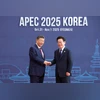
South Korean President Lee Jae Myung, right, welcomes Chinese President Xi Jinping to the Asia-Pacific Economic Cooperation (APEC) Economic Leaders' Meeting in Gyeongju, South Korea, Friday, Oct. 31, 2025. (Photo:PTI)


Listen to This Article
South Korean President Lee Jae Myung asked Chinese President Xi Jinping to make greater efforts to persuade North Korea to return to talks, as the two leaders on Saturday agreed on a set of agreements to expand their economic and other ties.
Their one-on-one meeting came hours after they and other Asia-Pacific leaders wrapped up their annual summit in South Korea with a joint statement pledging stronger economic cooperation. The two-day Asia-Pacific Economic Cooperation in the city of Gyeongju took place a day after Xi and US President Donald Trump agreed to dial back earlier steps and de-escalate their trade war.
During his meeting with Lee, Xi called for Seoul to work with Beijing to practice genuine multilateralism, according to Chinese state media, as he continued to position Beijing as the defender of the global trade order upended by Trump's sweeping tariffs.
Xi, Lee discuss North Korea Chinese state media reports on the Xi-Lee meeting didn't immediately carry any North Korea-related comments by Xi.
However, Wi Sung-lac, Lee's national security director, said Lee during the meeting outlined his strategy for achieving denuclearisation on the Korean Peninsula and requested a constructive Chinese role to help realise the resumption of talks with North Korea.
Also Read

 "north korea, tech workers, fake tech workers, us vs north korea")
 "Donald Trump boards Air Force One at Joint Base Andrews on Oct. 24")
 "Kim Jong, kim, jong, North Korea leader")
 "Li Qiang, Chinese Premier")
Xi replied that he would continue his efforts to help resolve issues involving the Korean Peninsula and promote peace and stability here, Wi said.
China is North Korea's traditional ally and economic pipeline, but there are still questions about how much leverage it has on its impoverished neighbour. China has long been suspected of avoiding fully implementing UN sanctions on North Korea and sending clandestine aid shipments to help the North stay afloat and continue to serve as a bulwark against US influence on the Korean Peninsula.
The North Korea item in the Lee-Xi meeting drew an irritated response from Pyongyang. North Korean Vice Foreign Minister Pak Myong Ho on Saturday slammed South Korea for talking about its daydream of realising North Korea's denuclearisation.
Lee, an advocate of reconciliation with North Korea, said earlier Saturday he would take more active preemptive steps to lower military tensions with the North, stressing that peace on the Korean Peninsula is essential to the prosperity of the Asia-Pacific region.
Lee's office said South Korea and China also signed several agreements on jointly combating online scams, expanding a bilateral free trade deal and renewing a currency swap deal that expired last month.
APEC leaders call for greater cooperation After two days of talks, APEC leaders vowed greater cooperation to tackle shared challenges in a global economy hit hard by rising protectionism and trade tensions between the United States and China, the world's two largest economies.
Their joint statement declared that the APEC leaders "acknowledge the global trading system continues to face significant challenges.
We reaffirm our shared recognition that robust trade and investment are vital to the growth and prosperity of the Asia-Pacific region, it says.
Jeonghun Min, a professor at South Korea's National Diplomatic Academy, said the statement avoided direct language supporting free and open trade, which would not have received backing from the United States, but still endorsed economic cooperation and multilateralism at the core of APEC's mission.
"It wasn't possible to leave that out entirely, said Min.
The joint declaration also said that APEC members remain committed to the Putrajaya Vision 2040, a new 20-year growth vision adopted in 2020 that calls for a trade environment that's free, open, fair, non-discriminatory, transparent and predictable.
APEC leaders discuss AI and population issues While the summit's opening session on Friday focused on ways to boost trade and investment, Saturday's meeting had cooperation in the field of artificial intelligence, demographic challenges and cultural industries on its agenda.
APEC leaders also issued two separate statements on Saturday. One called for a coordinated approach to the changes brought by AI, which they described as a potential economic catalyst that also poses challenges in rapidly evolving digital environments. The other urged cooperation to address declining birth rates, ageing populations and accelerated urbanisation.
Trump, known for his dismissal of multilateralism, had quickly left South Korea after the agreement with Xi, leaving the Chinese president to steal the limelight at the APEC summit.
On Friday, Xi told the summit that China would support global free trade and supply chain stability an apparent effort to position his country as an alternative to Trump's protectionist policies. In written remarks sent to a CEO summit held in conjunction with APEC, Xi said that investing in China is investing in the future.
Established in 1989, APEC champions free and open trade and investment to promote regional economic integration. But the region now faces challenges such as the US-China rivalry, supply chain disruptions, ageing populations and the impact of AI on jobs.
(Only the headline and picture of this report may have been reworked by the Business Standard staff; the rest of the content is auto-generated from a syndicated feed.)
More From This Section
 "Prince Andrew")
 "Barack Obama, Obama, Barack")
 "Mark Carney, Canada")
 "Rare earth minerals")
 "gold")
Don't miss the most important news and views of the day. Get them on our Telegram channel
First Published: Nov 01 2025 | 6:25 PM IST