Home / World News / Trump's new bridge threat came after Lutnick met rival crossing owner
Trump's new bridge threat came after Lutnick met rival crossing owner
On Monday evening the president said on Truth Social he'd prevent the Gordie Howe International Bridge from opening until Canada "fully compensated" the US, and said the US should own 50% of asset
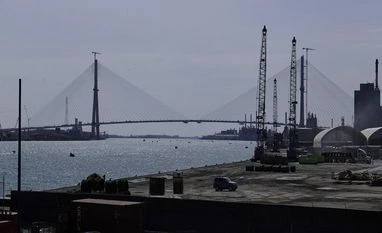
Construction of the C$6.4 billion ($4.7 billion) Gordie Howe bridge was paid for entirely by Canada | Image: Bloomberg
President Donald Trump’s threat to block a new bridge from Detroit to Canada followed a meeting between his Commerce Secretary and a billionaire who owns an existing border-crossing bridge just miles from the new span, according to two people familiar with the matter.
On Monday evening the president said on Truth Social he’d prevent the Gordie Howe International Bridge from opening until Canada “fully compensated” the US, and said the US should own 50 per cent of the asset.
The social media post followed a Monday meeting between Howard Lutnick and Matthew Moroun, whose family owns and operates the Ambassador Bridge, currently the busiest crossing over the border between Detroit and Windsor, Ontario, the people said. Following the meeting, Lutnick called Trump.
The White House declined to comment. Representatives for Detroit International Bridge Co., the company which operates the Ambassador Bridge, and other companies where Moroun holds roles did not immediately respond to a request for comment. The New York Times first reported the talks.
Construction of the C$6.4 billion ($4.7 billion) Gordie Howe bridge was paid for entirely by Canada. It’s largely complete and was due to open soon. In a deal agreed over a decade ago, Canada is set to receive toll revenues until it has recouped the construction cost, after which time that money will be split equally between Canada and Michigan. Both governments will co-own the asset. Both governments also appoint an equal number of members to an oversight body.
But the Morouns have long lobbied against Canada building a new bridge, which would rival their privately-held span.
In 2012, Matthew’s father Matty Moroun supported an unsuccessful statewide ballot in Michigan in an attempt to restrict the state’s ability to own or develop new international bridges. Matthew Moroun then lobbied Trump during his first term to rescind a waiver granted by President Barack Obama exempting the crossing from having to use only US steel. Matty Moroun died in 2020. Moroun companies have also filed lawsuits which would have obstructed the construction of the Gordie Howe bridge.
Trump’s involvement injects fresh uncertainty into the project.
The president wants to strike a deal with the Canadians over the Gordie Howe bridge, one of the people said. He spoke to Canada’s Prime Minister Mark Carney on Tuesday morning, who said Trump asked to involve his ambassador to Canada, Pete Hoekstra, who is from Michigan.
Trump’s broadside against Canada, the largest buyer of US exports, is the latest in a crescendo of tensions between the two countries as they prepare to review the economically critical US-Mexico-Canada Agreement trade deal, which Trump negotiated in his first term.
Trump’s rhetoric on Canada, such as calling for it to become a US state, had softened after Prime Minister Mark Carney replaced Justin Trudeau in an election last April. But it’s ramped up again since October, when Ontario Premier Doug Ford ran ads in the US quoting former President Ronald Reagan against tariffs. Trump terminated trade talks as a result, leaving in place large tariffs on key Canadian exports to the US like aluminum, steel and autos, as well as a 35 per cent tariff on the small amount of trade not covered by USMCA.
The Washington-Ottawa relationship deteriorated further in the last month, after Carney struck a tariff detente with Chinese President Xi Jinping and gave a speech in Davos, Switzerland which many saw as a critique and rallying cry against US foreign and trade policy. Since October, Trump has threatened to increase his 35 per cent tariff on Canada to 45 per cent, then floated a 100 per cent tariff, as well as a 50 per cent tariff on Canadian-made planes. None of those taxes have yet been imposed.

 "Trump's new bridge threat came after Lutnick met rival crossing owner")


