


A Short History of the Gaza Strip: Anne Irfan's book traces roots of crisis
Gaza, the city, is as old as the Old Testament in which it finds a mention. Gaza, the modern-day strip, was born in 1948, its fate entwined with the establishment and expansion of Israel
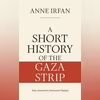 "A Short History of the Gaza Strip")
premium
A Short History of the Gaza Strip
5 min read Last Updated : Jan 20 2026 | 11:30 PM IST


Listen to This Article
A Short History of the Gaza Strip
by Anne Irfan
Published by
Simon & Schuster India
304 pages ₹699
The Gaza Strip has made headlines consistently for over two years and is now the focus of a dubious “Board of Peace” brokered by United States President Donald Trump. With the Hamas attack on October 7, 2023, a new generation of people inhabiting the internet became aware of the Palestinian cause for a sovereign state only to be quickly caught up in the activism to be on “the right side of history” as Israeli forces doubled down on making the strip an open-air prison. But as Anne Irfan points out in her book A Short History of the Gaza Strip, this cycle of repression and retaliation has been happening for decades on a different scale.
Gaza, the city, is as old as the Old Testament in which it finds a mention. Gaza, the modern-day strip, was born in 1948, its fate entwined with the establishment and expansion of Israel. Ms Irfan begins by describing briefly the historical importance of Gaza as the gateway to Palestine for centuries. During the reign of Ottomans, it was a hub for traders. The British held the Palestine Mandate after defeating the Ottomans during World War I. The Jewish state of Israel was formed on Palestinian land in 1948 with tacit acceptance from Britain and the then rising superpower, the US, forcing the inhabitants to seek refuge in the West Bank, and the newly formed Gaza Strip.
The strip that was inhabited by 80,000 people was filled with camps to cover more than 200,000 displaced refugees. Since then, their lives have been marked by humiliation and shame. They were forbidden from crossing the Green Line to visit their homes; those who had moved elsewhere could not re-enter the strip despite having family there.
Ms Irfan says that the history of what turned into a 141-square-mile enclave can be understood by six significant events: Dispossession of the Palestinians in 1948 (the Nakba), Egyptian rule from 1948, Israeli occupation from the Six Day War of 1967, the First Intifada of 1987, administration by the Palestinian Authority (PA) from 1994, and the rise of Hamas in 2007. The author doesn’t claim to provide solutions to this ongoing tragedy. As she points out, “To understand is not to justify; to explain is not to excuse.”
In 1948, before the Nakba (Arabic for Catastrophe), the United Nation suggested a two-nation plan that gave 55 per cent of the land to the Jews; it was rejected by the Arabs. Yet Israel, to this day, hasn’t declared its borders fully. It continues its occupation in the guise of defending itself against Hamas. Yet in an ironic chain of events in the 1980s, it had supported the Muslim Brotherhood — of which Hamas is an offshoot — through administrative approval and finances. It assumed that this Islamisation agenda could disrupt the rise of Palestinian Liberation Movement, which demanded a sovereign state. “As non-citizens subject to military law, they [the Palestinians] could be held in administrative detention for months or even years without charge or trial — all completely legal under the terms of the occupying regime.” Israel sought not only to empty Gaza of Palestinians but also, to fill it with Jewish Israelis.
During the mid-twentieth century, Gaza and the Palestinian had staunch global support. Many significant personalities, such as the Argentinian revolutionary Che Guevara, Jawaharlal Nehru, and African-American radical activist Malcolm X expressed overt solidarity with the Palestinians, something almost unimaginable today.
In 1993, after the First Intifada, the Oslo Agreement that brought the PA into power was a poor deal because it reduced even further the agency of the Palestinian people. The PA’s growing corruption did not help the Palestinian cause either. By then Hamas had established itself through expansive social welfare activities, which helped it win the elections in 2006.
At a time when misinformation is abundant, and communal voices increasingly assertive, this book unpacks the depth of the tragedy of a people who continue to be displaced and dispossessed. It brings light to Gaza’s resilience— subud — that has sustained the rebellion despite the dire conditions in which the Palestinians live. Ms Irfan highlights the many ironies in history that include major power players such as the British in the past and the US in the present. Her book begs many questions. Who is listening to the people? How much can activists do without falling prey to the diplomacy at play? Who holds Israel accountable?
Ms Irfan is a historian and lecturer in interdisciplinary race, gender and postcolonial studies at University College, London. Her book is rigorously researched with accompanying notes on the sources. Her simple and concise writing makes it a resourceful primer for anyone seeking to understand the complex events leading up to the present-day genocide in the Gaza strip.
X: @geekyliterati