


Negotiating India's Landmark Agreements: Historical lens on diplomacy
The author's research on the India-China Agreement on Tibet, 1954 was based on the Nehru papers from the Prime Minister's Museum and Library
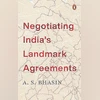 "book")
Listen to This Article
Negotiating India’s Landmark Agreements
Author: A S Bhasin
Publisher: Penguin
Pages: 336
Price: Rs 999
Also Read

 "How I Write: Writers on their Craft")
 "book")
 "Book Review")
 "Book Review")
 "book")
The author’s research on the India-China Agreement on Tibet, 1954 was based on the Nehru papers from the Prime Minister’s Museum and Library. He explains that the British policy of using Tibet as a buffer between India and China as demarcated by the contentious McMahon Line remained unrecognised by the latter. China wanted a fresh agreement with India to determine its trade relations with Tibet, which it had already annexed, though its status as an autonomous region was undecided. Mr Bhasin observes several climb-downs in India’s position and also shows how New Delhi missed the opportunity of a quid pro quo on the boundary issue. This lackadaisical approach is attributed to Nehru’s foreign policy that prioritised world peace in which China was to be a significant partner.
On the India-Soviet Union Treaty of 1971, Mr Bhasin provides a lucid account of the geopolitical complexities that underpinned its signing. Pakistan had come under the grip of the US and been co-opted into Southeast Asia Treaty Organisation and Central Treaty Organisation; President Richard Nixon was cozying up to China; the Soviet Union sought to limit Chinese influence with India as a counterweight; China resented western countries’ arms supply to India in the 1962 war; and in East Pakistan the repressive measures of the Pakistani Army led to civil war and caused a massive refugees influx into Bengal. Emboldened by her electoral victory in 1971, Indira Gandhi took a pragmatic view of the geopolitical confabulations and signed the treaty. It was not a military alliance but was significant as it marked, for the first time, a deviation from India’s Non-Alignment policy, Mr Bhasin observes.
Concluding the Simla Agreement in 1972 became essential for a number of reasons: To make Pakistan recognise Bangladesh; the release of more than 90,000 Pakistani political prisoners and the settlement of the Kashmir issue. The author emphasises that Mrs Gandhi’s assurance not to treat Pakistan as a vanquished power was a necessary palliative for a demoralised Pakistan, a latitude that allowed the final settlement of the Kashmir issue on the Line of Control (LoC) on a mutually acceptable basis to be deferred. Thus, the Simla Agreement is said to have provided an honourable exit for Zulfikar Ali Bhutto. Although the outcome had broadly met India's expectations, it is said to have reflected its weakness in being seen as the more anxious party for a peace settlement than the subdued Pakistan.
On the India-Sri Lanka Accord of 1987 Mr Bhasin says India’s readings were incorrect. Reconciling the ethnic differences of two citizens of the same country was a futile attempt, he argues. Indian leadership failed to gauge the popular sentiment against it in the island-nation. Eventually, it turned out to be an India-Liberation Tigers of Tamil Eelam war. In the end, India paid a huge price in the ignominious retreat of the Indian peacekeeping force, the IPKF, and the loss of lives, including that of Rajiv Gandhi.
The timing for concluding the India-US Nuclear Deal at the beginning of the millennium was perfect, Mr Bhasin asserts. He credits Condoleezza Rice, who went on to become US National Security Advisor and Secretary of State, for having understood the convergence of interests between the two countries and accordingly guiding US policy. Prime Minister Manmohan Singh was absolutely clear that American high technology was essential for the rapid economic growth and transformation of India. He deftly sought the political support of Samajwadi Party at the critical juncture when the Left tirade against the deal risked destabilising the government.
The final waiver from Nuclear Suppliers’ Group in September 2008 led to the adoption of the 123 Agreement by the Congress to seek an amendment to the US Atomic Energy Act 1954 so as to insulate India's nuclear facilities from supply disruptions, uphold its right to use spent fuel and also continue nuclear tests. Despite being a non-signatory to the Treaty on the Non-Proliferation of Nuclear Weapons, the deal put an end to the nuclear technology apartheid against India and, most importantly, paved the way for India to pursue its energy security. The author commends Indian negotiators for having proved more than a match for their US interlocutors and not blinking under pressure.
The agreements discussed in the book were spread over several decades. Some were rooted in history and some were the product of history. As each posed new challenges, it also provided some directions for the nation's journey in diplomacy. This treasure of a book underlines how an international agreement is the product of give and take and not based on friendship and bonhomie. Mr Bhasin’s book, thus, underscores the importance of developing expertise and experience in the art of negotiating with foreign powers.
The reviewer is a serving Indian Foreign Service officer
More From This Section
 "Return to Sri Lanka: Travels in a Paradoxical Island")
 "Will India get rich before it turns 100? A reality check")
 "Book Review")
 "Book Review")
 "book")
Topics : BOOK REVIEW Book diplomacy
Don't miss the most important news and views of the day. Get them on our Telegram channel
First Published: Jan 15 2025 | 11:07 PM IST