The JV plans to invest approximately Rs 5,000 crore to develop new energy vehicles (NEVs) and internal combustion engine (ICE) vehicles for both Indian market and exports.
At a media event in Mumbai on Wednesday to present their new model, the Cyberster EV sportscar, Sajjan Jindal, chairman of JSW Group, said: “With MG, my dream is to create a Maruti moment in new energy vehicles”. He further said he was “very excited” about this opportunity.
One of the key targets of JSW MG Motor India would be to bring down prices of NEVs closer to that of ICE vehicles.
The JV also aims to have sold 1 million electric vehicles in India by 2030 and to corner a third of the market. The company plans to increase production from 100,000 units to 300,000 units annually.
Rajeev Chaba, CEO emeritus of MG Motor India, unveiled the roadmap for JSW MG Motor India. Starting this September, the joint venture looks forward to launch a new car every three to six months, and also plans to eventually enter the premium vehicles channel and introduce a plug-in hybrid vehicle to India.
Parth Jindal, a member of the steering committee of JSW MG Motor India, said that India’s automobile market has enormous growth potential — from 4 million units in 2023 to 10 million units in about four years. “India’s GDP is at $4 trillion at the moment, which is where China was in 2005. Around 4 million passenger vehicles were sold in China in 2005, and now the Chinese automobile market is around 25 million in 2023, of which EVs constituted 8 million units.”
He further said JSW MG Motor India aims to capture a 33 per cent share of the NEV market by 2030.
Without disclosing a timeline for introducing the plug-in hybrid vehicle, Sajjan Jindal said that the plug-in hybrid vehicle technology is the transition phase between ICE vehicles and EVs. “Let’s assume that we have a car that can run 100-150 km per day on battery and is suitable for intracity use. When one wishes to take this car out of town, it will run the first 100 km on battery and then switch to another fuel. This is the interim solution until charging infrastructure develops," he said.
Currently, Maruti Suzuki, Toyota, and Honda sell hybrid cars in India. However, companies like Škoda have stated that it does not make sense to introduce a plug-in hybrid vehicle to India. Hybrids do not require external charging, while plug-in hybrids can be charged via an electrical outlet. Plug-in hybrids offer an extended electric-only driving range, whereas hybrids rely more on the gasoline engine.
JSW MG Motor India will expand its production capacity in Halol, Gujarat, with a focus on producing NEVs. This will significantly increase the production capacity from the current 100,000-plus units to up to 300,000 vehicles annually. The JV said will focus on strengthening its research, development, and technical prowess by setting up an R&D centre to cater to the different choices of car buyers.
The company is currently utilising over 60 per cent of its energy requirements for its manufacturing operations in Halol from renewable resources and is working towards becoming carbon neutral by 2029. JSW Group had earlier inked an MoU with the Odisha government to invest Rs 40,000 crore into setting up EV and battery manufacturing facilities in Cuttack and Paradeep. The project consists of a 50 GWh EV battery plant, EVs, Lithium refinery, Copper smelter, and related component manufacturing units.
Sajjan Jindal clarified that products from the Odisha investment would cater to the JSW MG Motor India JV company. In addition to this, the JV will also source steel from JSW. At present, MG Motor India hardly sources any steel from JSW Steel. Moreover, the JV is also looking at synergies on the supply side, on the logistics side (ports), and also marketing synergies.
MG Motor India currently provides 6,000 direct and indirect jobs, and Chaba said that going forward, the aim is to have a 50 per cent women workforce (up from 37 per cent). MG Motor sells MG Hector (SUV), MG ZS EV, MG Gloster (SUV), MG Astor (SUV), and MG Comet in the country.
51% JSW MG Motor India is held by Indians and is valued at Rs 5000 cr, said the company
8%: Indian financial investors


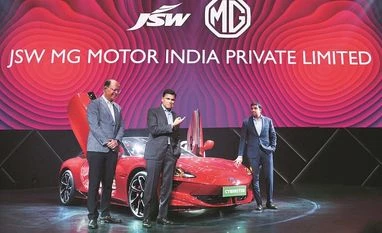 "Rajeev Chaba, CEO Emeritus of MG Motor India with Sajjan Jindal, chairman of JSW Group, and Parth Jindal, member of steering committee of JSW MG Motor India")