


India, Germany boost economic, technology and security ties ahead of EU FTA
Announce 27 outcomes, including 19 agreements, across sectors - from defence to semiconductors and supply chain
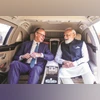 "German Chancellor Friedrich Merz conveyed ‘strong support' to PM Narendra Modi for the India-EU FTA, likely to be signed later this month")
German Chancellor Friedrich Merz conveyed ‘strong support’ to PM Narendra Modi for the India-EU FTA, likely to be signed later this month


Listen to This Article
India and Germany on Monday announced 27 outcomes — 19 agreements and eight announcements — to underline their deepening ties in defence, security, the mobility of health care workers, semiconductors, supply chains, technology, and green energy, and with an eye to enhancing bilateral trade in the context of the impending India-European Union (EU) trade deal.
During their discussions in Ahmedabad late Monday morning, German Chancellor Friedrich Merz, who is on a two-day visit to India, told Prime Minister Narendra Modi his country’s “strong support” for the India-EU free-trade agreement (FTA).
Merz asked the EU and New Delhi to “urgently conclude” trade talks, which would help strengthen supply chains disrupted over the past year.
The trade deal is slated to be signed on January 27 during the visit of European Commission President Ursula von der Leyen and European Council President Antonio Costa, both of whom will also be chief guests at this year’s Republic Day parade.
During his talks with Modi, and at their subsequent joint press briefing, Merz spoke of instability in the world order, and said it was ever more important for India and Germany to take their ties to a new level.
Also Read

 "Misri said, as the Prime Minister also noted during his statement, that the EU is a very large trading partner for India, but there is much more potential and scope to increase that trade")
 "Prime Minister Narendra Modi and German Chancellor Friedrich Merz")
 "German Chancellor Friedrich Merz, PM Modi")
He highlighted the “strategic approach” that Germany was taking in its relations with India to foster closer economic and security ties to counter the instability.
“Rough winds are blowing, and we must join forces to weather them,” Merz said. He said Germany wanted closer security cooperation with India so that it was less dependent on Russia.
Modi underlined the importance the German Chancellor placed on relations with India since it was “his first visit not only to India, but to Asia”, and that it was taking place as the two countries completed 25 years of strategic partnership last year.
Addressing a gathering earlier in the day, Merz said it was not a coincidence that his first visit to Asia, after taking over as Chancellor eight months ago, had been to India.
Bilateral trade in goods and services between the two nations has increased over 50 per cent in the past couple of years, and reached $51.23 billion, with Germany, India’s largest trading partner in the EU, accounting for over 25 per cent of India’s trade with the bloc.
The German leadership has been keen to double bilateral trade.
Germany is now home to 300,000 Indian passport holders, including 60,000 students, a number that has doubled in the past five years. The two sides discussed Germany setting up dedicated institutional arrangements to look at issues of Indian students and workers.
“Special emphasis has been placed on enhancing migration, mobility, and skilling. India’s talented young workforce is making a significant contribution to Germany’s economy,” Modi said, adding that the agreement on global skills partnership between the two countries would especially facilitate the mobility of health care professionals.
On defence ties, the Prime Minister thanked the Chancellor “for simplifying the processes related to defence trade”, adding that the two countries would work on a road map to enhance cooperation between their defence industries, “which will open up new opportunities for co-development and co-production”.
The two leaders also discussed global and regional issues in detail, including Ukraine and Gaza.
Germany committed itself to giving 1.24 billion euros under the flagship bilateral Green and Sustainable Development Partnership (GSDP), supporting priority projects in renewable energies, green hydrogen, PM e-Bus Sewa, and climate-resilient urban infrastructure, including metro networks in Surat and Ahmedabad.
Of the German government’s commitment of 10 billion euros until 2030, mostly as concessionary loans, a payment of approximately 5 billion euros has been used or earmarked since 2022 for projects.
The two sides signed agreements on defence industrial cooperation, setting up a chief executive officers’ forum, semiconductor ecosystem partnership, green hydrogen and critical minerals. A framework agreement for recruiting health care professionals and another for setting up a centre of excellence for skilling in Hyderabad were also signed.
Germany announced visa-free transit for Indian passport holders. The two sides agreed to set up a foreign policy and security dialogue, another on Indo-Pacific.
Germany said it would open an honorary consulate in Ahmedabad.
On defence ties, the two sides endorsed the commitment to deepen military-to-military cooperation through joint exercises, and training and exchanges of senior officials.
Both leaders lauded the continuing cooperation in submarines, obstacle avoidance systems for helicopters, and Counter Unmanned Aerial Systems (C-UAS), and looked forward to enhanced defence industrial collaboration.
India and Germany are negotiating a $8 billion submarine-manufacturing deal.
Merz has been accompanied by two dozen German business leaders, including the chief executive officers of Siemens, DHL Group, Infineon Technologies, Uniper and Airbus Defence and Space. There are also managers from several small- and medium-sized companies from the so-called Mittelstand, which form the backbone of Germany’s once powerful, but now struggling manufacturing sector.
As Modi noted, more than 2,000 German companies are doing business in India.
The two sides signed a road map on higher education, and said they were committed to the goal of expanding the teaching of the German language in India, including in secondary schools, universities and vocational education centres.
The two leaders also visited the Sabarmati Ashram. In a note in the ashram visitors' book, Merz stated, “Mahatma Gandhi's unshakeable belief in the power of freedom and dignity of each and every individual inspires us to this day. This legacy unites Indians and Germans as friends in a world that may more than ever be in need of Gandhi's teachings.”
On his second day in India on Tuesday, Merz is slated to visit the Indian Institute of Science and a Bosch facility in Bengaluru.
With inputs from agencies
More From This Section
 "Inflation, Consumer Price Index, retail inflation")
 "TAx")
 "Swaminathan J, Deputy Governor, RBI")
 "India, Indians, mumbai, population, economy")
 "Ashok Gajapathi Raju")
Topics : India Germany India-EU FTA Green energy Defence
Don't miss the most important news and views of the day. Get them on our Telegram channel
First Published: Jan 12 2026 | 9:54 PM IST