


China launches IOMed global mediation as alternative to ICJ, UN court
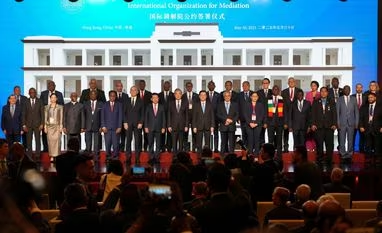
At a high-level signing ceremony in Hong Kong, Chinese Foreign Minister Wang Yi presided over the formal adoption of Convention on the Establishment of the International Organisation for Mediation
 "International Organization for Mediation")
Chinese Foreign Minister Wang Yi, Hong Kong Chief Executive John Lee, Pakistan's Foreign Minister Ishaq Dar and Swiss Foreign Minister Ignazio Cassis pose for photos after a signing ceremony of the Convention on the Establishment of The International
Listen to This Article
China on Friday formally established a new international dispute resolution body, the International Organisation for Mediation (IOMed), positioning it as a global alternative to traditional institutions such as the International Court of Justice (ICJ) and the Permanent Court of Arbitration.
China’s state-run Global Times newspaper described IOMed as the “world’s first intergovernmental international legal organisation dedicated to resolving international disputes through mediation”, stating that it would “fill a critical gap in mechanisms focused on mediation-based dispute resolution”.
IOMed to be headquartered in Hong Kong; offer mediation-only model
At a high-level signing ceremony in Hong Kong, Chinese Foreign Minister Wang Yi presided over the formal adoption of the Convention on the Establishment of the International Organisation for Mediation. Indonesia, Pakistan, Belarus, Cuba, and Cambodia were among more than 30 countries who joined China as founding members. Delegates from around 50 countries and 20 international organisations, including the United Nations, were also present.
Headquartered in Hong Kong, IOMed is the first intergovernmental international legal organisation dedicated to resolving international disputes solely through mediation, according to China’s state media. It aims to handle disputes between states, between a state and nationals of another country, and international commercial disagreements, offering a more flexible alternative to traditional legal adjudication or arbitration.
Also Read

 "Chinese rocket scientist")
 "US VISA")
 "cargo ship, flight, US flight, plane, airplane")
 "China-Japan flag")
 "oil tankers, sea shore, trading")
Wang Yi emphasised China’s long-standing commitment to resolving international issues through dialogue and consensus, rather than confrontation. “The establishment of the International Organisation for Mediation helps to move beyond the zero-sum mindset of you lose and I win,” Wang said, asserting that the body reflects Chinese diplomatic values and global aspirations for more harmonious conflict resolution.
IOMed adds to China’s influence in global south
With many developing countries backing the initiative, the move adds to China’s growing influence in the global south, particularly amid strained relations with the West.
China has also sought to leverage the initiative to reassert Hong Kong’s international standing. Once a vibrant financial hub, the city has faced sustained economic stagnation and reputational decline following its return to Chinese rule in 1997 and Beijing’s increasing political control in recent years.
Despite the ceremonial launch, many operational details of IOMed remain unclear. Questions also persist over its perceived impartiality and credibility, particularly given China’s leading role and Hong Kong’s current political climate. Nevertheless, Beijing insists that the new body will adhere to the principles of the UN Charter and international law.
More From This Section
 "Shashi Tharoor, Shashi, Tharoor")
 "New Pakistan COAS, Asim Munir")
 "Jet engines")
 "Shashi Tharoor,Shashi")
 "Russian Foreign Minister Sergei Lavrov speaks at a press conference, during the G20 summit, in New Delhi, Photo: Reuters")
Topics : China BS Web Reports United Nations
Don't miss the most important news and views of the day. Get them on our Telegram channel
First Published: May 30 2025 | 3:57 PM IST