Chef Manu Chandra, who founded Single Thread Catering in March 2022, was back at the conference after three years to whip up Indian treats for those in attendance.
“We had a lot of learnings from the last time and knew that with so many global heads of state present, planning was sacrosanct.
Nothing could be left to the last minute. While we made everything fresh, it was all prepped in advance,” said Chandra, who flew to Davos two days ahead of the event.
Staying at the apartments of Davos residents, which are emptied before the event starts, Chandra and team used to trek for over an hour in the snow to reach the kitchen. They were sharing it with another London-based chef and his team.
With a three-day networking extravaganza in -10 degree celcius, the idea was to serve hot and wholesome food that could be had on-the-go.
With no sit-down buffet type provision, form and presentation mattered as much as the taste and quality, he says. And so, the days kicked off with a dal tadka soup shot, made of a moong base with the tadka oils used as garnish.
Chandra curated a different menu for each of the three days, paying homage to three different parts of the country.
Paying homage to states south of the Vindhyas, the chef paired madur vadas with a white asparagus pallya, a pullimunchi with black salsify — a Spanish root vegetable, and a bajra khichdi, among others.
“It was local Indian food, with a touch of Europe but did not compromise the soul,” he said.
In a nod to Bengaluru’s bakery culture, there was filter coffee tiramisu, biscuits from the famous Iyengar Bakery replaced the Italian ladyfingers, filter coffee decoction was mixed into the cream, and the dessert topped with a filter coffee foam instead of cocoa powder.
When serving food from Assam, West Bengal and Bihar, mustard in the shorshe prawns were replaced with Swiss mustard and the traditional kheer kadam was reimagined as an Austrian Linzertorte, with a raspberry flavoured rasgulla wrapped in sandesh and a layer of biscuit crumb on top.
When serving food from Punjab, UP, and Delhi, there was a bowl of piping hot rajma chawal, “which reminds me of winter lunches after school in Delhi,” he says.
To make sure the Indian flair to the dishes was perfect, Chandra carried with him three different types of rice from different regions for each day, nachni (ragi) from the southern states, and radhuni and kashundi from Bengal, among others.
His favourite moment was when former UK Prime Minister Rishi Sunak visited the pavilion and tried several of the creations.
“In an environment where people are always on the move, it is difficult to catch someone’s attention. Luckily for us, Rishi Sunak spent some time exploring our menu,” Chandra says.
Food really is soft power, he added. “And this year, the gravitas was even greater with US President Donald Trump, Ukrainian head of state Volodymyr Zelenskyy, and even Elon Musk. It was also monumental, considering the state of the world today,” he says.
He adds, “Events like these also add a lot of credibility to what we do, and small wins like showing people how far India has come all make for endearing memories.”


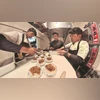 "Chef Manu Chandra founded the Single Thread Catering in March 2022")