


India among nations willing to cut tariffs under Trump push: US Trade Rep
Jamieson Greer says nearly 50 countries, including India, Argentina, Vietnam, and Israel, have shown interest in easing trade barriers as part of the Trump administration's push for reciprocity
 "Donald Trump, Trump")
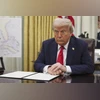
US President Donald Trump (Photo: PTI)
Listen to This Article
US Trade Representative Jamieson Greer has said India is among several nations now considering tariff reductions, suggesting that the trade policies implemented under President Donald Trump are beginning to show results.
While defending the administration’s trade-related national emergency before the Senate Finance Committee, Greer pointed out the disparity in agricultural tariffs, noting that the US maintains an average rate of 5 per cent, compared to India’s 39 per cent.
“Our average tariff on agricultural goods is 5 per cent, but India’s average tariff is 39 per cent. You understand the trend here. Our trade deficit, driven by these non-reciprocal conditions, is a manifestation of the loss of the nation’s ability to manufacture, to grow, and to build. The President recognises the urgency of the moment,” said Greer.
He identified India, Argentina, Vietnam, and Israel as examples of countries open to lowering tariff and non-tariff trade barriers in response to President Trump’s emphasis on achieving ‘reciprocity’ in trade relations.
‘50 countries have approached’
“Companies have announced $4 trillion into investments in the United States. Nearly 50 countries have approached me personally to discuss the President's new policy and explore how to achieve reciprocity. And they’ve spoken with many members of the administration,” Greer said.
Also Read

 "White House, US, United states")
 "Donald Trump, Trump, Benjamin Netanyahu, Benjamin")
 "Karoline Leavitt, US press secretary")
 "Cornwell University")
 "Marco Rubio")
He added that some of these nations — specifically India, Argentina, Vietnam, and Israel — have expressed willingness to ease trade restrictions in accordance with the administration’s approach.
According to Greer, the widening US trade deficit and the erosion of its manufacturing base are largely the result of “one-sided tariffs, trade barriers, and economic policies adopted by foreign partners,” rather than market dynamics.
Also Read: RBI MPC Meeting LIVE
‘Trade tied to national security’, says Greer
Describing the situation as a “national security emergency,” Greer said these trade practices have significantly impacted American workers. He highlighted that the US has lost approximately five million manufacturing jobs and 90,000 factories since 1994.
He also pointed out that America, which once enjoyed a trade surplus in agriculture, saw a reversal during the final two years of the Biden administration.
Greer said Trump’s broad trade policy overhaul — featuring baseline global tariffs and increased duties on steel, aluminium, vehicles, and certain parts — has led nearly 50 countries to enter talks with the US.
“Several of these... have suggested that they will reduce their tariffs... in line with the President’s policy,” he said.
Donald Trump’s reciprocal tariffs
On April 2, President Trump announced sweeping reciprocal tariffs during a White House Rose Garden ceremony, dubbing the day ‘Liberation Day’. These tariffs aim to address trade imbalances by imposing rates equivalent to those levied on US exports by foreign nations. A universal 10 per cent baseline tariff was introduced for all imports, while higher country-specific tariffs, ranging from 20 per cent on European Union goods to 26 per cent on Indian products, were outlined.
Trump described the initiative as a “declaration of economic independence” to revitalise US manufacturing.
[With agency inputs]
More From This Section
 "Sheikh Hasina")
 "United Nations Security Council")
 "Sri Kartarpur Sahib Corridor")
 "Modi, Narendra Modi")
 "India-EU FTA")
Topics : Donald Trump Trump tariffs US India relations United States Trump administration BS Web Reports US tariffs
Don't miss the most important news and views of the day. Get them on our Telegram channel
First Published: Apr 09 2025 | 9:47 AM IST