


English now official in US: Impact on Indian, other immigrants explained
Immigration experts say India, where English is widely spoken, could see its professionals and students benefit from the decision
 "English, American English")
Immigration policies have long required applicants to demonstrate English proficiency before obtaining US citizenship. Photo: Shutterstock
Listen to This Article
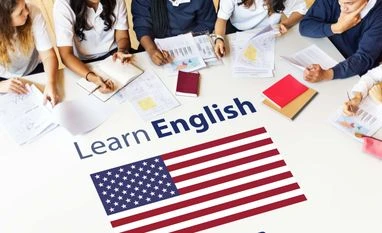
The United States has officially declared English as its national language, a change that came into effect on March 1, 2025, after US President Donald Trump signed an executive order. Until now, the US was one of the few countries without an official language, despite English being the dominant mode of communication.
“It is long past time that English is declared as the official language of the United States,” said Trump while announcing the order.
Immigration experts say India, where English is widely spoken, could see its professionals and students benefit from the decision.
What does the order mean?
Government agencies and federally funded organisations can now decide whether to offer documents and services in languages other than English.
Also Read

 "Donald Trump, Trump")
 "EB-5 visa")

 "deported, deportation")
 "Modi, Narendra Modi")
It reverses a 2000 policy signed by former President Bill Clinton, which required federal bodies to provide language assistance to non-English speakers.
'Without a doubt, this is good for Indians'
During his 2024 campaign, Trump often mentioned non-English languages when advocating stricter immigration policies.
"It's the craziest thing—they have languages that nobody in this country has ever heard of. It's a very horrible thing," he told supporters in February 2024.
However, immigration policies have long required applicants to demonstrate English proficiency before obtaining US citizenship. Nearly 80% of the US population speaks only English, making the change largely symbolic for many.
Immigration experts believe the order could be beneficial for Indians, who generally have strong English proficiency.
“Without a doubt, this is good for Indians,” Ajay Sharma, founder of Abhinav Immigration Services told Business Standard. “Amongst all skilled professionals and overseas students in the US—whether Chinese or others—Indians use the English language the best, in speaking, reading, writing, and listening. They are well-positioned to meet the eligibility requirements of such regulations.”
Mamta Shekhawat, founder of the study-abroad platform Gradding.com, shared a similar view. “Diverse languages are often an asset in a multicultural society like the US. However, declaring English as the official language will encourage uniformity in communication. This will have a positive impact on Indian immigrants, workers, and students,” she told Business Standard.
She also pointed out that English proficiency tests are already mandatory for admission to top US universities.
The executive order justifies the move by stating, "Speaking English not only opens doors economically, but it helps newcomers engage in their communities, participate in national traditions, and give back to our society."
Varun Singh, MD of XIPHIAS Immigration, said the order could reinforce the advantage Indian professionals already have.
“India has long enjoyed an edge in global mobility due to its English-speaking population. For Indian professionals in the US, this order may validate their linguistic proficiency, potentially making them more competitive in the job market,” he said in a written response to Business Standard's query..
Employers may prioritise candidates with strong English skills, while those already fluent will likely find it easier to navigate government and workplace interactions.
However, Singh warned that the policy could create challenges. “Many skilled workers and students from India, while proficient in English, often rely on multilingual support for legal, administrative, or community services. If the order leads to a reduction in translation services and language assistance programmes, those with limited fluency might struggle to access crucial resources.”
He also pointed out that while Indian immigrants generally have an advantage, an official language declaration should not lead to exclusion. “The US has thrived as a land of diversity, and policies should continue to reflect its openness. Skilled Indian professionals and students bring immense value to the American economy, and ensuring their smooth transition should remain a priority.”
Who will be most affected?
The order does not mandate immediate structural changes to federal programs but strengthens the position of the English-only movement.
< English is already the official language of 32 states and five territories in the US.
< Alaska, Hawaii, and South Dakota, along with Guam, Northern Mariana Islands, Puerto Rico, and the US Virgin Islands, recognise at least one language in addition to English.
< New Mexico, Oregon, Rhode Island, and Washington have "English Plus" policies, supporting multiple languages.
According to the US Census Bureau, nearly 68 million of the country’s 340 million residents speak a language other than English at home. This includes more than 160 Native American languages. Spanish, Chinese, and Arabic are the most spoken languages after English.
A New York Times report highlighted concerns that the order could disproportionately impact the estimated 42 million Spanish speakers and three million Chinese speakers in the US. Many in these communities rely on multilingual services for daily life, from healthcare to legal support. Critics warn that limiting these resources could create barriers and increase discrimination against non-English speakers.
More From This Section
 "Credit Card")
 "Here are a few tips on how to increase your credit score quickly")
 "Money")
 "H1B visa")
 "Money, Loan, Economy, Capital, Rs, Rupee, Indian Currency")
Topics : US immigration policy BS Web Reports
Don't miss the most important news and views of the day. Get them on our Telegram channel
First Published: Mar 04 2025 | 4:14 PM IST