


US firms can buy Gold Card for $5 million to hire top Indian grads: Trump
Defending the move, Trump said the new scheme would allow American businesses to recruit top graduates from Ivy League and other leading universities
 "Donald Trump, Trump")
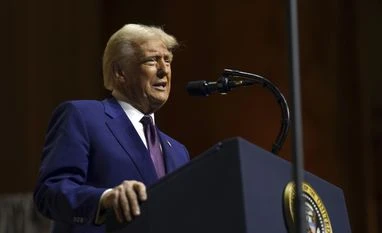
US President Donald Trump Trump said the new Gold Card would allow American businesses to recruit top graduates from Ivy League and other leading universities Photo: PTI


Listen to This Article
US President Donald Trump on Wednesday decided to replace the employment-based EB-5 visa scheme with a 'gold card' programme that would grant US citizenship to immigrants willing to pay $5 million.
Defending the move, Trump said the new scheme would allow American businesses to recruit top graduates from Ivy League and other leading universities. “I get calls from, as an example, companies where they want to hire the No. 1 student at the school, person comes from India, China, Japan, lots of different places, and they go to Harvard to Wharton School of Finance, they go to Yale,” Trump said during his first full Cabinet meeting of his second term on Wednesday.
Business interest in new scheme
Under the plan, companies could buy the gold card to help secure immigration status for prospective employees.
“These companies can go and buy a gold card, and they can use it as a matter of recruitment,” Trump said. He predicted the programme would be popular with businesses, adding, “I happen to think it’s going to sell like crazy. It’s a bargain.”
Also Read

 "deported, deportation")
 "US citizenship, United States, US")
 "Donald Trump, Trump")
 "US Visa")
 "Eric Adams")
Trump unveiled the proposal on Tuesday alongside commerce secretary Howard Lutnick, stating that the initiative could start within two weeks without requiring congressional approval. However, immigration experts argue that lawmakers would likely need to authorise such a shift.
Impact on EB-5 investors
The existing EB-5 visa programme allows foreign investors and their families to gain permanent residency by investing in US businesses and creating at least 10 jobs.
Lutnick suggested that the gold card programme could replace EB-5, but industry experts point out that EB-5 remains in effect.
“Investors must note that as of now the EB-5 programme remains in effect. From its inception, the EB-5 programme has been legislated by Congress, and under the EB-5 Reform and Integrity Act of 2022 (RIA), it was reauthorised through September 30, 2027. Any changes to the programme would require congressional approval,” Piyush Gupta, Vice President, India and Middle East, CanAm Enterprises, a company specialising in EB-5 investments, told Business Standard.
Investor protections also remain in place for those already participating in EB-5. “The statutory grandfathering provision guarantees that investors who file their petitions before September 30, 2026, will be processed under the current law and have EB-5 visas available. This statutory safeguard ensures continuity and stability for investors, shielding them from potential programme modifications or executive policy shifts,” Gupta explained.
Immigration lawyers say the gold card scheme differs substantially from EB-5.
“The increase from $1 million to $5 million may be the most obvious difference between the EB-5 programme and Trump’s ‘golden visa,’ but it is definitely not the most dramatic change,” said Russell A Stamets, partner at Circle of Counsels, in comments to Business Standard.
“The EB-5 was subject to certain abuses, but it required showing that investment would create US jobs. The golden visa sounds more like a concierge service,” Stamets said. “Of course, less wealthy people who hoped to build businesses and lives in the US may be locked out of the new golden visa.”
Trump has suggested that selling 1 million gold cards could generate $5 trillion for the US government, which he said could help pay down national debt. However, immigration experts believe far fewer individuals would be able to afford participation in the scheme.
The administration is still finalising vetting requirements for gold card applicants.
Individuals who opt into the scheme would pay the funds directly to the US government. While Trump sees it as a lucrative option, critics argue it could reduce access for entrepreneurs looking to invest and create jobs in the US.
More From This Section
 "EB-5 visa")
 "Money, Loan, Economy, Capital, Rs, Rupee, Indian Currency")
 "Equity Mutual Fund")
 "stock market")
 "Housing, Houses, Apartments, residential building")
Topics : US immigration
Don't miss the most important news and views of the day. Get them on our Telegram channel
First Published: Feb 27 2025 | 10:06 AM IST