


US migrant detention hits record 59,000 as Trump ramps up arrests
US holds record 59,000 migrants in detention as daily arrests nearly double under Trump's second-term crackdown
 "Donald Trump, Trump")
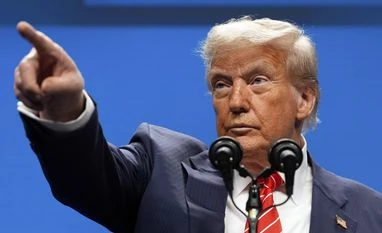
President Donald Trump points as he speaks during a media conference at the end of the NATO summit in The Hague, Netherlands, Wednesday, June 25, 2025.(Photo: PTI)
Listen to This Article
The United States is holding a record number of migrants in immigration detention, as President Donald Trump’s second administration accelerates mass arrests across the country.
By June 23, 2025, US Immigration and Customs Enforcement (ICE) was detaining around 59,000 people—far above the 41,500-bed limit set by Congress and the highest figure in US immigration history, according to internal data obtained by CBS News.
Just under half of those currently held—about 47%—have no criminal record at all, and fewer than 30% have been convicted of crimes.
Arrests nearly double, but fall short of target
Also Read

 "elderly, old age")
 "Social Media")
 "Spain")
 "H-1B Visa")
 "US visa interview")
In June so far, ICE has averaged 1,200 arrests per day, peaking above 2,000 on two occasions. That’s nearly double the average during the early months of Trump’s second term, but still short of the 3,000 daily target reportedly set by White House adviser Stephen Miller.
The current detainee count surpasses the previous high of around 55,000 recorded in 2019, during Trump’s first term. Two former ICE officials told CBS they had never seen the agency detain so many people at once.
Who is being detained?
According to government figures:
47% of detainees have no criminal record
Fewer than 30% have criminal convictions
Many were arrested in workplace raids or during targeted operations across major cities
While ICE has the authority to detain anyone suspected of immigration violations, the broadening scope of arrests now includes individuals with no prior offences.
Official messaging stresses violent crime
Despite these numbers, Trump administration officials continue to link the detention drive with public safety.
“In LA, what we have been going after is the worst of the worst,” said Homeland Security Secretary Kristi Noem in an interview with Fox News. “They are murderers. They are people who have been perpetuating assault and trafficking human beings.”
DHS Assistant Secretary Tricia McLaughlin said, “ICE targets the worst of the worst—including gang members, murderers, and rapists. In President Trump’s first 100 days, 75 per cent of ICE arrests were criminal illegal aliens with convictions or pending charges.”
A recent press release from DHS highlighted 11 individuals arrested in Los Angeles—10 of whom had records involving violent or drug-related crimes.
Pressure from the White House for mass arrests
Internal discussions suggest that the White House is pushing for a sharp increase in arrests. Top adviser Stephen Miller and Secretary Noem have reportedly asked ICE to arrest 3,000 individuals a day—three times the average daily arrest rate in Trump’s early second term, according to a cable made public earlier this month.
To support this surge, the administration is seeking $147 billion in immigration-related funding over the next decade and has signed contracts to expand detention centre capacity. It has also revived the 287(G) programme, which allows state and local police to enforce immigration laws.
White House spokesperson Abigail Jackson said at a press conference, “We are committed to aggressively and efficiently removing illegal aliens from the United States, and ensuring our law enforcement officers have the resources necessary to do so. The safety of the American people depends upon it.”
Interior arrests replacing border detentions
With border crossings at historic lows, the focus has shifted from the border to the interior. Data from the Transactional Records Access Clearinghouse (TRAC) shows that ICE made around 65,000 deportations in the first 100 days of Trump’s second term, up from a daily average of 759 during President Biden’s final year.
The administration has also petitioned the US Supreme Court to overturn a Massachusetts court ruling that requires a 10-day notice before deporting migrants to third countries. The filing follows a dispute over attempts to deport individuals convicted of crimes to South Sudan.
What to do if approached by ICE
Abhisha Parikh, a US-based immigration attorney, posted a list of precautions on Instagram for people approached by ICE:
• Stay calm and don’t run
• Ask if you are free to leave—if yes, walk away
• Ask to see badges; ICE officers often wear “Police” on uniforms
• Remain silent if questioned
• Don’t resist or reach for items suddenly
• You can refuse searches of your car, phone or home unless there’s a judge’s warrant
• Never present false documents or lie
• If undocumented, say you wish to remain silent and want a lawyer
• Don’t sign anything before speaking with a legal adviser
Few legal pathways for undocumented
Legal recourse is limited for undocumented Indians in the US, especially those with criminal convictions.
Ajay Sharma, founder of Abhinav Immigration Services told Business Standard, “There are not many legal pathways for those on illegal status, especially the ones with criminal records. Even those without criminal records who try to file in any permitted category must leave the country once to get new status validated, and the probability of being denied re-entry is still very high.”
More From This Section
 "Canada Indian")
 "US Visa")
 "london")
 "New Zealand")
 "qatar, doha")
Don't miss the most important news and views of the day. Get them on our Telegram channel
First Published: Jun 27 2025 | 3:38 PM IST