


Delhi AQI: Thick smog blankets city as AQI breaches 400, air turns 'severe'
Stagnant winds and a western disturbance are trapping pollutants over Delhi, pushing AQI beyond 400 in parts of NCR and prompting health warnings for residents
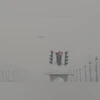 "Smog, Delhi Pollution, Delhi Air Quality, Pollution")
The 24-hour average AQI on Monday was 309 (‘very poor’), slightly better than Sunday’s reading of 366, though the overall improvement was marginal (Photo: PTI)
Listen to This Article
The air quality in the national capital continued to deteriorate on Tuesday, slipping into the ‘severe’ category as thick smog persisted across the region. At 8 am, the Air Quality Index (AQI) at Anand Vihar stood at 409, according to the Central Pollution Control Board (CPCB). Most monitoring stations across Delhi and the surrounding National Capital Region (NCR) reported AQI levels above 300, ranging between ‘very poor’ and ‘severe’.
How is pollution affecting residents?
The worsening air quality has once again raised health concerns, particularly for vulnerable groups such as children, the elderly, and those with respiratory illnesses. Doctors have advised residents to restrict outdoor activities during morning and evening hours, when pollution tends to peak.
#WATCH | Delhi: Visuals around Akshardham area as a layer of haze lingers in the air. AQI around the area is 392, categorised as 'Very Poor' by the Central Pollution Control Board (CPCB). pic.twitter.com/LbkMfd1tXH
— ANI (@ANI) November 4, 2025
The 24-hour average AQI on Monday was 309 (‘very poor’), slightly better than Sunday’s reading of 366, though the overall improvement was marginal. Environmental experts noted that the haze has been consistently reducing visibility during the early hours and late evening, contributing to increased complaints of throat irritation, coughing, and breathing discomfort.
Why are air quality readings inconsistent?
Discrepancies in air quality data have also emerged. Stations such as ITO, one of the city’s busiest traffic intersections, reported ‘moderate’ air quality at certain hours on Monday. However, a closer look revealed that several hours of data were missing, resulting in unusually low readings, according to a report by Hindustan Times.
Also Read

 "Smog, Delhi Pollution, Delhi Air Quality, Pollution")
 "air pollution, marathon")
 "Supreme Court, SC")
 "Smog, Delhi Pollution, Delhi Air Quality, Pollution")
 "Smog, Delhi Pollution, Delhi Air Quality, Pollution")
According to CPCB’s Sameer app, the AQI at ITO was shown as low as 80 (‘satisfactory’) at 8 am on Monday, raising concerns about monitoring consistency.
Will air quality worsen further this week?
According to Sunday’s Early Warning System (EWS), the air quality is expected to worsen further and remain in the ‘severe’ range through Tuesday before showing slight improvement on Wednesday. Meteorologists attribute the deterioration to a western disturbance, which has reduced wind speeds and caused stagnation — conditions favourable for pollutant accumulation.
Experts warn of a fresh smog build-up around November 4 and 5, driven by continued stubble burning in neighbouring states and low wind movement.
What is the weather forecast for Delhi?
The sky will remain mainly clear, with mist or haze likely to persist over the next five days.
Maximum temperature is likely to remain between 28 and 30 degrees Celsius while the minimum will be around 16 to 18 degrees Celsius, according to the India Meteorological Department (IMD).
Light wind speeds towards evening are expected to further trap pollutants near the surface, worsening air quality later in the day.
More From This Section
 "voters,vote,voting,election,voter")
 "Accident, road accident")
 "Representative Picture")
 "Dev Deepawali Kashi, Dev Deepawali Varanasi, Kashi festival of lights, Kartik Purnima celebrations, Ganga aarti Varanasi, Uttar Pradesh tourism, cultural festivals India, soft power India, diyas festival, Kashi ghats, Ganga Mahotsav, Indian heritage")
 "Mehul Choksi")
Don't miss the most important news and views of the day. Get them on our Telegram channel
First Published: Nov 04 2025 | 9:40 AM IST