


Home / India News / Urban water crisis persists as cities underinvest in supply systems
Urban water crisis persists as cities underinvest in supply systems
Despite adequate water availability, India's cities continue to face recurring shortages as weak governance, poor planning and underfunded municipal bodies undermine water management
 "Water tanker, water crisis, heatwave")
premium
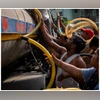
Since water supply projects are capital-intensive, all state governments control and run the infrastructure for water supply to towns | Photo: Bloomberg
6 min read Last Updated : Jun 16 2026 | 9:07 PM IST
Listen to This Article
Every summer, Indian cities are faced with a common problem: water cuts and an increasing reliance on private water tankers for uninterrupted supply. This is not surprising, given that most major Indian cities' spending on water supply is woefully inadequate despite their growing populations.
Not surprisingly, this has given rise to so-called 'informal water markets'. A study by L Venkatachalam of the Madras Institute of Development Studies noted that poor households in Chennai often purchase water from these informal markets, incurring significant expenditures. “The informal water markets require regulation and monitoring to better serve low-income households. Improvements in public water supply could significantly enhance the welfare of the urban poor”, the study noted. The same argument, though, could well be extended to other parts of any Indian city.
Meanwhile, for the 10 largest cities in India by population, data on actual spending on water is either dated, like Chennai, or in some cases not available at all. What's more, there is no pattern to the annual expenditure on water facilities across the country.
In Mumbai, the Brihanmumbai Municipal Corporation (BMC) allocated 12.45 per cent of its total FY27 capital expenditure of Rs 48,164 crore for water supply projects, a 8.75 per cent increase over FY26 and the highest share for the department in recent years.
Bengaluru has remained stagnant, with the total water budget constant at just above Rs 1000 crore.
Delhi, too, has flatlined its water supply expenditure: For FY27, the allocation to the Delhi Jal Board is Rs 9,000 crore but most of it will go to service its debt of Rs 34,540 crore as of March 2022 (as per the latest audit report from the Comptroller and Auditor General).
In cities like Hyderabad, the needle on capital item “Loans for Water Supply and Sanitation” hasn't moved from Rs 635 crore in FY26 to FY27. Kolkata has been struggling to meet a Rs 135 crore capital expenditure item to increase the supply of water for the city since FY23. In Pune, municipal corporation records show there has been no audit of the water supply and demand position since FY22. Indore, reeling from contaminated water-related deaths in March this year, has raised its FY27 allocation for water supply and scavenging to Rs 2,600 crore. But for the state as a whole, the allocation of 1.7 per cent of the total budget for water (rural and urban combined) is sharply lower than the 3.4 per cent the year before.
It is not that India has a shortage of water resources. According to the study “Reassessment of Water Availability in India using Space Inputs, 2019”, conducted by the Central Water Commission, the country receives an average annual precipitation of about 3,880 billion cubic metres (BCM). After accounting for natural losses such as evaporation and other factors, the average annual water available in the country is estimated at 1,999.20 BCM.
The bigger problem lies with oversight. Since water supply projects are capital-intensive, all state governments control and run the infrastructure for water supply to towns. For instance, the Chennai Metropolitan Water Supply and Sewerage Board is run by the state government, similar to the arrangement for the Delhi Jal Board. This leaves little say for municipal corporations in water management in the very cities they manage.
Meanwhile, research is increasingly finding that water insecurity in Indian cities is not merely a challenge of scarcity or climate change, but is deeply rooted in socio-political structures and fragmented governance regimes.
“To address these challenges, more than anything, we require city-specific research and policies with a shift toward integrated resilience-focused sustainable water management strategies”, notes a recent study by Aamod Kumar Karmaksh and Ashwani Kumar, of the National Institute of Technology in Hamirpur.
The results, reflected in the municipal disarray, are obvious. The water parastatals, just as in the case of electricity, recover barely two-thirds of their expenses. CAG data from 2022 (latest available year for municipal bodies) shows that Water Charges of Urban Local Bodies (ULB) during the five-year period of 2016-20 have seen a decline in collection from 67 to 58 per cent.
The 74th Amendment to the Constitution recognised that key functions for the cities, including water supply, should be under municipal governance. But most states, despite the promise of transferring the work of realising the revenues to the third tier, have not adequately empowered them in terms of provisioning either functionaries or funds to manage water supply effectively.
The solution has also been recognised by the central government. The National Urban Sanitation Policy-2008 (NUSP-2008) requires state governments to prepare State Urban Sanitation Strategies to ensure the assignment of responsibility to the ULBs. A 2025 NITI Aayog report notes that “States are required to make concerted efforts to devolve powers, roles and responsibilities along with financial and personnel resources necessary for ULBs to discharge their functions”. The policy had suggested that the ULBs should be accorded wide-ranging powers, which means taking over control of water supply from the parastatals.
Even the Swachh Bharat Mission guidelines prescribe that without a proper City Sanitation Plan and State Sanitation Strategies, the Mission cannot fully succeed. Here, too, repeated CAG audits observe that state governments often do not prepare a statewide sanitation strategy to devolve full powers, roles, and responsibilities, along with financial and personnel resources necessary, to ULBs to discharge this core municipal function as per NUSP-2008 and SBM guidelines.
But the ULBs suffer from both a lack of funds and a coherent plan on how to deploy whatever funds they get. For instance, there is a policy for water budgeting but it is applicable only for rural areas under the Atal Bhujal Yojana, with no urban equivalent. The Varuni web application uses a cycle-based approach to compare water availability (supply) with water requirements (demand) to generate a comprehensive water budget. It indicates whether a given block experiences a surplus or a deficit. It further provides contextual insights into local geography and water resource conditions. However, these programmes are run by the central government, which has a mandate to examine only rural areas. For urban areas, it seems, state governments have neither the time nor the money to develop an equivalent.
Topics : water supply Water crisis Finance News