


Onion deflation at 6.5-year high in September amid subdued exports
So far in this current financial year (2025-26), only April saw a moderate inflation of 2.85 per cent in onions and since then it has seen a deflation in every succeeding month.
 "onions, onion")
premium
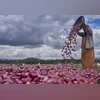
Chikkamagaluru: A farm worker dries the harvested onions at an agricultural field near Chikkamagaluru, Karnataka, Sunday, Sept. 14, 2025.(Photo: PTI)
5 min read Last Updated : Oct 25 2025 | 5:03 PM IST
Listen to This Article
Onion prices are once again seeing prolonged periods of deflation. Consumer price index (CPI) based deflation in onions was recorded at -49.85 per cent in September, which was a six-and-a-half-year high.
This is the steepest deflation rate recorded in onions since February 2019 (see chart).
So far, in this current financial year (2025-26), only April saw a moderate inflation of 2.85 per cent in onions and since then it has seen a deflation in every succeeding month.
The unusual trend
The latest price slump has come during a period when traditionally onion prices tend to soar. While this unusual fall is benefiting consumers, growers are at the receiving end.
Onion prices tend to increase during the lean months of September to December, as the stored rabi harvest is almost exhausted while the early kharif harvest is yet to arrive in the markets. The price spike gets exacerbated if the early kharif harvest is impacted due to surplus rains.
However, this year, none of this has happened.
While the southwest monsoon has been surplus in many parts, and it has impacted the standing crop in several parts of Maharashtra, it has not pushed up their prices.
A main reason for this, according to some market players, is that traders are sitting on huge stockpiles of onions produced during the previous rabi harvest and warehouses are filled with onions from the previous season.
Trade estimates that almost 40 per cent of stored rabi onions are still lying in the warehouses which is keeping a tab on prices and pulling it downwards.
Another big reason for this glut in the domestic markets is the continued drop in exports primarily due to loss of the lucrative Bangladesh market which accounted for 40 per cent of the overseas shipments.
India produced around 25 million tonnes of onions in 2023-24 making it among the world’s largest producers of the crop.
And it usually exports around 1-2 million tonnes every year. The crop is usually planted three times in a year.
First is kharif which is planted in between July and August and harvest sometime October-December, then is late kharif which is planted in around October-November and harvested in January-March and the third is rabi onions which is planted between December and January and harvested between March and May.
Of the three, rabi onions contribute around 75 per cent of the country’s total annual production and are more storable as compared to the others.
The lost Bangladesh market
Ever since India adopted a stop and start policy when it came to onion exports, Bangladesh — which accounted for almost 40 per cent of India’s annual onion exports — has been scouting for alternatives.
The country has also simultaneously started growing its own onions to cut down reliance on imports.
The result of all this, trade sources say, is that the lucrative export market of Bangladesh has shifted to India’s competitors in the global onion trade which are Pakistan, Egypt, Turkey and China who have stepped up their sales to the neighbouring country. The balance is being met through domestic production.
“This whole stop-and-start policy in onion exports has meant that one of our most lucrative markets for exports, that is Bangladesh, is on the verge of getting permanently lost,” Danish Shah, a leading onion exporter and market expert, told Business Standard.
He said globally, too, there is overproduction of onions which is why demand has slumped in most other countries as well.
“In August, India exported around 100,000-125,000 tonnes of onions which is just 40 per cent of our normal capacity,” Shah explained.
He said other major export destinations for India’s onion exports, which are Sri Lanka and West Asian countries, have also cut down on Indian onions and have either started growing their own crop or shifted their purchases to some other countries.
“Our bans and curbs have severely dented India’s credibility and we are no longer considered a reliable trading destination when it comes to onions,” Shah lamented.
The curbs
India first banned exports of onions in December 2023 to control domestic prices. Thereafter, after some months, the ban was lifted in May 2024 but was replaced with a Minimum Export Price (MEP) of $500 per tonne along with an export duty of 40 per cent. Then in September 2024, the Centre even abolished the MEP and lowered the duty from 40 per cent to 20 per cent which continued till April 1, 2025.
On April 1, 2025, all sorts of curbs on exports were lifted but by that time the market had already moved on.
“This has made the period from December 2023 to April 2025 one of the longest times when onion exports were placed under some sort of control or the other,” the trader said.