


China starts first regular container service through Arctic: Why it matters
The service, officially called the China-Europe Arctic Express and branded by the Chinese carrier as the 'Ice Silk Road', will sail along Russia's Northern Sea Route
 "shipping, maritime")
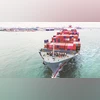
China starts shipping service through Arctic (Representative image from file)
Listen to This Article
On August 15, Chinese shipping company Sea Legend launched the first regular weekly container service using the Arctic’s Northern Sea Route to connect China with Europe. The service, called the China-Europe Arctic Express or the “Ice Silk Road”, will sail along Russia’s Northern Sea Route (NSR).
It gives a shorter alternative to the traditional Suez Canal route, as disruptions around key West Asia shipping chokepoints have prompted countries to look for alternative trade routes.
Route and transit time
Sea Legend’s service runs from Ningbo-Zhoushan in eastern China to Felixstowe in the UK, sailing along Russia’s northern coast through the NSR. The Arctic route stretches about 5,500 km along the Russian coast.
The direct journey can take as little as 18 days, according to Sea Legend chief operating officer Li Xiaobin, compared with more than 40 days through the Suez Canal, The Guardian reported.
Sea Legend's first scheduled sailing is being operated by the 1,740-TEU container ship Dubai Tower, which is travelling from Ningbo-Zhoushan in China to Felixstowe in the UK. The company has planned eight weekly sailings between August and October during the Arctic navigation season.
Also Read

 "Reserve Bank of India (RBI)")
 "Black hole star")
 "Telangana, Maharashtra and Haryana are creating or proposing agriculture-only Discoms to restructure farm power distribution, subsidies and finances.")
 "TCS")
 "Tukaram Mundhe")
The NSR is navigable only during part of the year. According to Reuters, the route is typically open from July 1 to October 1. Sea Legend plans to operate its container service during the warmer months, before ice conditions become more difficult.
Why the Arctic route matters
The shorter route reduces sailing time and fuel use. The Wall Street Journal reported that Sea Legend completed a trial voyage from Asia to Europe in 2025 in about 20 days, which roughly half the time of a voyage around the Cape of Good Hope.
The Arctic route has become more accessible as summer sea ice has declined. The report said that nearly half of the Arctic’s summer ice has melted over the past five decades.
The Arctic has warmed about four times faster than the global average over the past four decades. This has extended the seasonal window for commercial shipping, Reuters said.
The route is also being considered due to disruption and security concerns around traditional shipping lanes. Sea Legend’s Li told Guardian that the West Asia crisis had exposed the vulnerability of the Suez Canal and Strait of Hormuz and increased the need for alternative China-Europe trade routes.
A route still facing limits
While there are advantages, one of the biggest limitations of the route is that it remains seasonal. It also carries a lot of operational risks due to its difficult weather.
Ships face changing weather, ice floes and the need for icebreaker assistance. Insurance costs are also higher. The Wall Street Journal report said that Arctic insurance premiums are about 40 per cent higher than for the Cape of Good Hope route.
The route also remains small compared with established shipping corridors. A record 23 cargo ships used the Northern Sea Route last summer, compared with more than 30 ships transiting the Suez Canal every day, according to the Wall Street Journal.
“It’s not the Suez Canal but it’s a significant number for the Arctic. It shows there is potential,” Malte Humpert, founder of the Arctic Institute, told the Wall Street Journal.
Environmental risks are another concern, heavy fuel oil spills can be difficult to clean in Arctic conditions, while black carbon emissions can contribute to further warming, the Guardian reported.
China’s Arctic shipping push
China’s move follows several years of activity along the Northern Sea Route.
As of now, Russia controls much of the Northern Sea Route. Its state nuclear company Rosatom issues navigation permits and provides nuclear-powered icebreakers for vessels that require assistance.
The Arctic route is also seeing greater use for Russian oil shipments. Last week, Reuters reported that seven crude cargoes carrying about 6 million barrels were already heading to Asia through the NSR, nearly half the volume shipped through the route during the whole of 2025.
More From This Section
 "us iran, us flag, iran flag")
 "A fire following a Russian missiles attack is seen in Kyiv, Ukraine")
 "Sergio Gor")
 "meta")
 "Nestle, Nestle India")
Don't miss the most important news and views of the day. Get them on our Telegram channel
First Published: Aug 17 2026 | 2:51 PM IST