


 "Vladimir Putin, Putin, Donald Trump")
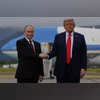
Days after hosting Russian President Vladimir Putin in Alaska, US President Donald Trump has reportedly told his Ukrainian counterpart Volodymyr Zelenskyy to give up parts of Crimea and drop Kyiv’s Nato ambitions in return for a ceasefire.
What went down between Trump and Zelenskyy
Trump held an hour-long meeting with Zelenskyy at the White House on Monday as part of a fast-tracked push to find a settlement acceptable to both Russia and Ukraine. Following their talks, the duo joined European leaders in discussions aimed at breaking the deadlock, with Trump warning that the prolonged conflict risked spiralling into a Third World War.
While Washington has described Trump's formula as a call for “compromise", the onus has been placed firmly on Kyiv. Zelenskyy, however, has already rejected the idea, saying Ukraine cannot concede territory occupied by Russia.
What exactly did Trump propose to Ukraine?
Trump said Zelenskyy could “end the war almost immediately, if he wants to,” by accepting Russian control over Crimea and shelving Ukraine’s Nato membership bid. He claimed this would open the way for a ceasefire.
The suggestion follows Trump’s high-profile meeting with Putin in Alaska on August 15, where he welcomed the Russian leader with a red-carpet reception. According to reports, Moscow is unwilling to return all of the Ukrainian land it has seized but could show flexibility if Kyiv meets two central demands: recognition of Russian control over Crimea and a halt to its Nato ambitions.
Also Read

 "brain eating amoeba")
 "cancer patient doctor")
 "National highway")
 "Indian travellers, Travel, tourism, Travel portals")
 "Ozempic")
Zelenskyy has rejected both ideas, including a separate condition that Ukraine would also give up more of the eastern Donetsk region.
Why is Crimea central to the Russia-Ukraine dispute?
Crimea has been a faultline in the Russia-Ukraine relationship for more than a decade. After deploying unmarked armed troops to Crimea in March 2014 (in violation of international humanitarian law) as protests broke out in Kyiv, the Kremlin annexed the peninsula and held a referendum (which was declared illegal by the international community) to officially formalise the annexation.
The move triggered Western sanctions on Russia and marked the sharpest breakdown in its relations with the West since the Cold War. Domestically, however, it fuelled Russian nationalism. Putin’s approval ratings jumped from 65 per cent in early 2014 to 86 per cent by June that year, according to pollster Levada Center.
For Putin, Crimea has become both a strategic and symbolic asset. Moscow has prosecuted activists, especially those from the Crimean Tatar community, who continue to oppose Russian control.
How did political chaos in Ukraine create an opening for Crimean annexation?
In late 2013, Ukraine was rocked by mass protests against the then-president Viktor Yanukovych who abandoned plans to sign a political association deal with the EU in favour of closer ties to Moscow.
The protests, which came to be known as the Maidan uprising, was at first a small protest, which then stretched into months, eventually forcing Yanukovych out of office in February 2014. Riding the instability, Putin sent troops to seize Crimea.
The swift and largely bloodless speed of the takeover stunned Ukraine’s allies. A referendum was organised soon after, which Russia said showed overwhelming support for joining the Russian Federation. Western governments, however, dismissed it as illegitimate.
What is Crimea’s historical and cultural significance?
Crimea was part of the Russian Empire and later the Soviet Union for centuries before being transferred to Ukraine in 1954 by Soviet leader Nikita Khrushchev. Though both countries were then under the USSR, many Russians considered Crimea their own.
This historical memory has been repeatedly invoked by Putin, who argues that Russia is protecting ethnic Russians in the region. Ukraine, meanwhile, sees the peninsula as part of its post-independence identity, especially since it has been part of the country for over six decades.
What makes Crimea strategically important?
Crimea's position on the Black Sea provides it both military and economic significance. Russia's Black Sea Fleet is stationed in Sevastopol and provides Moscow a naval power base. Control over Crimea also extends Russia's ability to control patrolling of key shipping routes, as well as offshore oil and gas reserves.
Ukraine saw the loss of Crimea as a reduction of its access to the Black Sea, and thus, its economic opportunities and leverage in energy access and trade routes. Both countries see the peninsula as critical to controlling grain and other goods' exports through the Black Sea corridor.
How did Crimea shape the war after 2014?
After the annexation, fighting erupted in eastern Ukraine between Kyiv’s forces and pro-Russian militias. Moscow denied sending troops or weapons, but mounting evidence showed otherwise. A Dutch court concluded that a Russia-supplied missile shot down Malaysia Airlines Flight MH17 over eastern Ukraine in July 2014, killing 298 people.
Hardline Russian nationalists later criticised Putin for stopping short of taking more Ukrainian territory at the time, arguing that Kyiv was vulnerable and its army in disarray.
The standoff continued until February 2022, when Moscow began a full-scale invasion. Crimea was key to this invasion. Russian troops and equipment were launched from the peninsula, so Moscow was able to seize huge amounts of southern Ukraine very quickly.
Since then, Crimea has again become an area of conflict. Ukraine now attacks the peninsula with drones and missiles, focusing on Russian military infrastructure. The Black Sea Fleet has been repeatedly hit, and the Kerch Bridge, which links Crimea to Russia - making it a symbol of Moscow’s hold - has been struck three times, in 2022, 2023 and June 2025.
Why does Crimea remain at the heart of peace efforts?
For Putin, Crimea is non-negotiable. He has repeatedly made recognition of Russian sovereignty over the peninsula one of his conditions for peace, alongside demands that Ukraine cede four other occupied regions: Donetsk, Luhansk, Zaporizhzhia and Kherson. Alongside, it wants Ukraine to drop its Nato bid, remain non-nuclear, and restrict its armed forces.
Meanwhile, Kyiv has refused to concede any territory. Zelenskyy has pledged to retake Crimea, arguing that Russia “won’t be able to steal” it permanently.
As of now, Russia holds around 20 per cent, or a fifth, of Ukrainian territory, including Crimea. Any agreement that freezes the war on current frontlines would leave Moscow with significant territorial gains.
 "Drone")
 "Air Canada, Air Canada protest")
 "The Widener Library on Harvard's campus in Cambridge, Massachusetts")
 "US flag, united states")
 "Shanshan, Tropical storm Shanshan")

