


Israel complicates Trump's push for peace with Iran amid Lebanon offensive
President Trump said he had asked Prime Minister Benjamin Netanyahu to scale back Israel's military campaign in Lebanon
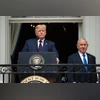 "Trump, Donald Trump, Netanyahu, Benjamin Netanyahu")
Netanyahu cares far more about the presence of Iran-backed Hezbollah fighters in Lebanon than about the Strait of Hormuz, which Iran militarized in response to the war
Listen to This Article
By Michael Crowley
Weeks of harmony between President Trump and Prime Minister Benjamin Netanyahu of Israel as they waged war against Iran is coming under strain as Trump’s search for a peace deal exposes divergences between their respective long-term goals.
Their differences may force Netanyahu to accept compromises on his ambitions to crush Hezbollah in Lebanon and bring down Iran’s battered clerical leadership in the name of preserving relations with Trump, who appears eager to strike a deal with Tehran.
Trump said on Thursday that he had asked Netanyahu to scale back Israel’s military campaign in Lebanon, which threatened the two-week truce only a day after it took effect.
Netanyahu cares far more about the presence of Iran-backed Hezbollah fighters in Lebanon than about the Strait of Hormuz, which Iran militarized in response to the war, while Trump’s overriding priority appears to be allowing oil to pass through the waterway.
Also Read

 "BSE, Stock Markets")
 "Benjamin Netanyahu, Benjamin, Netanyahu, Israel PM")
 "Iran, Tehran")
 "ship, vessel, tanker, Hormuz")
 "Xi Jinping, China")
Netanyahu sees Iran’s regime as vulnerable and would prefer not to let up military or economic pressure on Tehran. Trump appears eager to conclude a war that has spiked gas prices, troubled his supporters and threatened his political standing.
Vice President JD Vance is set to lead a US delegation to Islamabad this weekend for talks with Iranian officials, who hope to win relief from US economic sanctions.
Senator Mark Warner of Virginia, the top Democrat on the Senate Intelligence Committee, singled out Netanyahu in a social media video message depicting Trump’s cease-fire with Iran as a farce. Israel’s continued attacks on Hezbollah fighters in southern Lebanon, which drew Iranian threats to negate the cease-fire deal, showed that Netanyahu “continues to be the outsourced leader of American foreign policy,” Warner said.
But Trump asserted himself in a Wednesday phone call with Netanyahu, he told NBC News on Thursday, in which he pressed the Israeli leader not to endanger his diplomacy with Iran.
“I spoke with Bibi and he’s going to low-key it” in Lebanon, Trump said, referring to Netanyahu by his nickname.
By Thursday afternoon, Netanyahu had announced that Israel would begin direct negotiations with Lebanon over its goal of disarming Hezbollah, and a US official said the State Department would host a meeting to discuss the matter in Washington next week.
It is unclear whether that will be enough to satisfy Iranian officials. Netanyahu said that his military was “continuing to strike Hezbollah with full force,” and Israeli officials accuse Hezbollah of violating the cease-fire with cross-border rocket barrages.
Natan Sachs, a senior fellow at the Middle East Institute, said that Netanyahu’s goal was to deflect pressure from the United States without giving up on his military goals in Lebanon. But Sachs said there were limits to how much Netanyahu is willing to test Trump’s patience. The American president is very popular in Israel, making Netanyahu’s partnership with Trump his chief political asset at home as Israel prepares for national elections this year.
“Nothing looms larger in his mind than Trump,” Sachs said of Netanyahu. Whereas Netanyahu paid little price at home for brushing off demands from President Joseph R. Biden Jr., who was not popular among Israelis, the dynamic has flipped, particularly among Netanyahu’s most conservative supporters.
“‘Trump asked me to do this’ is a valid excuse with his right flank,” Sachs said.
Unwilling to split openly with Trump, Netanyahu will likely make a vigorous private case to the US president for hard bargaining — and a return to war if necessary — with Tehran.
Even if Trump strikes a deal that the Israeli leader views as too conciliatory, Sachs added, Netanyahu might bide his time and, after attention has drifted from the conflict, come to Trump with new intelligence about Iranian malfeasance or other arguments for renewed action.
It remains unclear how the fighting in Lebanon became subject to different interpretations.
Prime Minister Shehbaz Sharif of Pakistan, whose country mediated the deal, said Tuesday on social media that the United States and Iran, “along with their allies,” had agreed to an immediate cease-fire “everywhere including Lebanon and elsewhere.”
But Israel and the United States both insisted that was not the case. Vance on Wednesday chalked it up to a “reasonable misunderstanding.”
Hezbollah has been a mortal enemy of Israel for more than 40 years, since its creation, with help from Iran in response to Israel’s 1982 occupation of southern Lebanon.
Israel routinely clashed with the group but until recently had not mounted an all-out campaign to destroy it. The Oct. 7, 2023, Hamas attacks in Israel changed Netanyahu’s strategic calculus, and the Israeli leader now considers Hezbollah’s elimination an urgent priority. For Trump, by contrast, Lebanon is “a tertiary priority at best,” Sachs said.
More differences may emerge with Netanyahu as Trump negotiates a potential deal with Iran in the coming weeks. Some Iranian capabilities, such as Tehran’s medium-range ballistic missiles and its support for Hezbollah, Hamas and other proxy groups pose a greater threat to Israel than to the United States.
But every demand Trump makes of Iran will require something more in return. It is unclear how much he is willing to give up to protect Israeli interests as opposed to purely American ones — above all shipping through the Strait of Hormuz.
In exchange for allowing vessels to pass freely through the vital strait, Iran is demanding that Trump lift the crushing sanctions the United States has imposed on its economy over many years. Yet Netanyahu has long called for “maximum pressure” on the country, to starve its government of funding for Hamas and Hezbollah and possibly even to cause its clerical regime to fall.
In an address to his people after the announcement of Tuesday’s cease-fire, Netanyahu said he fully supported Trump, but also made clear that he considered business in Iran to be unfinished.
Israel still “has more goals to complete” in Iran, he said. “We will achieve them,” he added, “either through agreement, or through renewed fighting.”
More From This Section
 "Apple, Apple store")
 "Iran, Iran flag")
 "Vikram Misri, Marco Rubio, Sergio Gor")
 "china Flag, China")
Topics : Benjamin Netanyahu Donald Trump Israel Iran Conflict US-Iran tensions US Iran tensions Lebanon israel
Don't miss the most important news and views of the day. Get them on our Telegram channel
First Published: Apr 10 2026 | 8:55 AM IST