


As wars intensify, their carbon toll remains off climate summit agendas
From Gaza to Ukraine, the environmental cost of conflict rivals top emitters but is missing from global climate policy and accountability frameworks
 "Bad news for the earth: Climate action scepticism rises among policymaker")
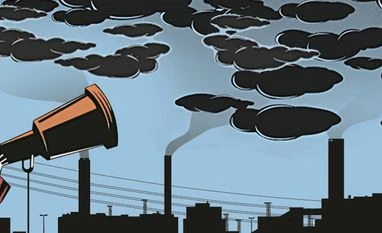
Illustration: Ajaya Mohanty
Listen to This Article
As world leaders prepare for another global climate summit (COP30 in Brazil this November), the skies over Gaza, Ukraine, and other war-ravaged regions remain filled with the smoke of bombs, fuel, and concrete dust. Despite decades of climate diplomacy, the carbon toll of armed conflict remains off the books.
Militaries are among the most energy-intensive institutions globally. The US Department of Defense alone consumed more oil in 2017 than many nations, emitting 59 million tonnes of CO₂—comparable to Sweden or Switzerland. Yet, the Paris Agreement exempts military emissions from mandatory reporting.
According to the UK-based Conflict and Environment Observatory, global military activity is responsible for 5.5 per cent of greenhouse gas emissions. If treated as a country, this would place it fourth after China, the US, and India.
How do wars and weapons amplify global emissions?
The environmental toll of modern warfare is enormous. A single Tomahawk missile detonation emits around 800 kg of CO2. Fighter jets like the F-15 can burn 6,000 litres of fuel per hour, releasing over 15 tonnes of CO2—many times more than a car emits in a year.
One week of heavy bombardment, such as in the Iraq War or Gaza 2023, can equal the emissions of 100,000 passenger vehicles annually. Brown University’s Costs of War study estimated that US-led wars since 2001 have added 1.2 billion tonnes of CO2 e—similar to Japan’s yearly emissions.
Also Read

 "Natarajan Chandrasekaran")
 "Blood test")
 "Unified Payments Interface, UPI")
 "Delhi High Court")
 "VinFast VF7")
Israel-Gaza conflict reveals staggering environmental impact
Between October 2023 and January 2025, the Israel-Gaza war released an estimated 1.89 million tonnes of CO2 equivalent:
- 50 per cent from Israeli airstrikes and weaponry
- 20 per cent from production of arms and military transport
- 130,000 tonnes from diesel use in Gaza after solar systems were destroyed
- 70,000 humanitarian trucks accounted for 40 per cent of logistics-related emissions
- Gaza now holds 37 million tonnes of debris contaminating groundwater and soil. Rebuilding the strip using conventional materials may add another 30 million tonnes of emissions—surpassing New Zealand’s annual output.
Russia-Ukraine war and its long-term carbon toll
Since 2022, Russia’s invasion of Ukraine has generated 230 million tonnes of CO2 e—comparable to Belgium’s emissions. In 2024 alone:
- War-related wildfires burned 92,100 hectares
- Fires released 25.8 million tonnes of CO2
- Aviation rerouting caused 14.4 million tonnes of excess emissions
- Attacks on energy sites added 2.1 million tonnes
The 2023 breach of the Kakhovka Dam flooded estuaries and released industrial waste. Two Russian oil tankers leaked 6,000 tonnes of mazut into the Black Sea, severely harming marine life.
Legacy of war: Vietnam, Rwanda, Gulf War and beyond
Historic conflicts offer stark reminders of ecological devastation:
- Vietnam War used 73 million litres of chemical defoliants, halving the country’s mangroves.
- Rwandan civil war displaced 750,000 into forests, erasing 105 sq km of greenery.
- Gulf War fires released 500,000 tonnes of pollutants daily.
- Israel-Lebanon war (2006) spilled 15,000 tonnes of oil into the Mediterranean.
Environmental fallout goes beyond the battlefield
Military training zones cover 5–6 per cent of Earth’s surface. Over 2,000 nuclear tests since 1945 have poisoned ecosystems. Refugee displacement (114 million people) adds pressure to host ecosystems, often increasing poaching and deforestation.
Armed conflict affects 615 endangered species, vastly more than the IUCN list suggests. The preparation for war—constructing vehicles, testing weapons, and drilling—burns immense resources even before combat begins.
How military land use and fuel habits shape the climate
Military bases often sit in ecologically fragile zones. Vegetation is stripped, land is compacted, and pollutants from drills persist for decades. Globally, up to 6 per cent of land is either owned or used by military installations.
Militaries operate massive fleets: the US military alone runs over 13,000 aircraft and 800 ships. In 2017, the US Air Force spent nearly $5 billion on fuel—more than many countries’ entire emissions budgets.
Weapons manufacturing and disposal increase ecological cost
Weapons production is carbon-intensive. Jets like the F-35 require over 300,000 parts, many of which involve mining and transporting rare metals. Old weapons systems corrode, leak toxins, and contaminate land and water, especially in less regulated environments.
The invisible climate cost of global defence logistics
Military supply chains span the globe. Troops, munitions, fuel, and food are flown or shipped across continents. NATO conducts over 200 joint exercises a year, often involving large-scale troop movements—each adding to the military’s massive carbon footprint.
Why are military emissions not on the climate agenda?
Despite $950 billion pledged since 2009 for climate finance, military emissions remain excluded. Under pressure from the US, the Kyoto Protocol (1997) exempted military reporting. The Paris Agreement only allows voluntary disclosure.
Most countries don’t report military emissions, and those that do under-report significantly. As global militarisation rises, this emissions blind spot undermines climate commitments.
More From This Section
 "Donald Trump, US President")
 "Iran-Israel war")
 "Iran, Iran flag")
 "iran, pakistan")
 "Iran-Israel war")
Don't miss the most important news and views of the day. Get them on our Telegram channel
First Published: Jun 16 2025 | 5:22 PM IST