Magnus Carlsen has written a Facebook post (
goo.gl/GY6SXJ) suggesting changes in the title format. He wants an annual event like the World Cup, with knockout mini-matches. The title is the biggest property Fide controls and it's entirely Fife's call. So any discussion of a format change is theoretical, unless Fide President, Kirsan Ilyumzhinov, wants it.
Would the brand value of "world champion" be devalued by a KO? Arguably, it was so in the 1990s. The probability of any given player winning drops in a short-match KO. Carlsen remains favourite. But he is less likely to win a KO.
KOs also lead to tiebreaks at short time controls, giving stronger rapid and blitz players an edge. Preparation changes in emphasis since deep prep cannot be easily aimed at specific players. Finally, KOs also place stress on stamina and nerves and thus favour younger players in general.
The financial implications are interesting. Would prize money summed over three KOs exceed the total prize money for one Candidates event and one multi-million title match every three years? Also, how would that prize money be distributed? As of now, eight candidates, and the reigning champion get paid in a title sequence with champion and runners up getting the lion's share.
Sponsoring a KO involves hosting 64 (or 128) players for three days; 32 players for another three days; then 16 for three more days, et cetera, down to two players for a final 5-day match (assuming 4 classical games plus tiebreaks). Prize money is divided tennis-style with small initial payoffs, building up to generous later payouts. The cash is spread out more in KOs.
The KO prize money could be boosted. Carlsen is financially-savvy. He would have sent out feelers, done some hisaab and reckoned that his payoffs from three annual KOs would exceed the payoff from one match every three years. Other strong players may also prefer an annual jamboree. But it's all up to Kirsan Ilyumzhinov in the end.
Meanwhile, the Asian Continental Championships and Russia's superfinals are on. Saleh Salem won the Asian Classical event with 7 pts from 9 games and a better tiebreak than Surya Ganguly (also 7). S P Sethuraman, Vidit Gujrathi and Zhou Jianchou tied for third-fifth (all 6.5).
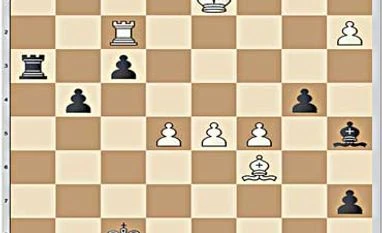
The DIAGRAM, BLACK TO PLAY, (White: Andrey Vovk Vs Black: Granda Zuniga, Andorra Open 2015), is a crazy endgame. Black found 48--b3! The mate can't be parried by 49.axb3 Rh1+ 50.Kc2 Be1! Play went
49.Rf1 Rh2!? (Looks like 49.--bxa2 50. Kc2 Rh2+ is easier.)
50.axb3 Ra2 51.d6 Ra1+ 52.Kc2 Rxf1 53.e6 Bd8! 54.Bb5 Rc1+ 55.Kxc1 g3 56.c6 g2 57.c7 g1Q+ 58.Kc2 Qc5+ 59.Kb1 Bf6! Once black avoids 59...Bxc7?? 60.e7+, it ends with
60.Ba6 f2 61.Bd3 Qc3 (0-1).
Devangshu Datta is an internationally rated chess and correspondence chess player

 "Chess (#1161)")


 Connect with us on WhatsApp