Education's 'non-profit industrial complex'

What makes the book riveting is Ms Tukdeo's view of policy as socially and culturally constructed
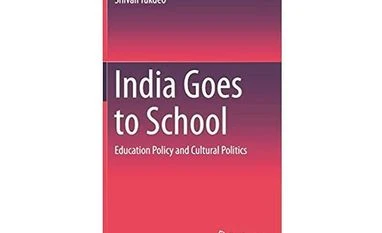
India Goes to School
Cover of India Goes to School.
Chintan Girish Modi
4 min read Last Updated : Feb 20 2020 | 2:42 AM IST
“How do we make sense of the enormous expansion of educational institutions and desires to access these spaces despite them being exclusionary, disciplining and alienating? How do caste-blind assumptions and caste-driven practices impact everyday schooling and institutional cultures? How do educational ideals such as equality, autonomy and respect begin to change as they begin their institutional lives?” asks Shivali Tukdeo in her book India Goes to School: Education Policy and Cultural Politics. She is an Associate Professor in the School of Social Sciences at the National Institute of Advanced Studies in Bangalore where she has been researching social exclusion and changing modes of public education in India, with special attention to new policy regimes and how these are shaped by the international development discourse as well as nationalism. 

What makes this book riveting is Ms Tukdeo’s view of policy as socially and culturally constructed. She draws on feminist, post-colonial and anti-caste literature to critique policy frameworks that masquerade as apolitical while they diligently serve “neoliberal directives...using technological interface and the rhetoric of efficiency and transparency.” She writes scathingly about “the non-profit industrial complex,” which has been responsible for mainstreaming “capitalist solutions to social problems” by replacing mass struggles for social change with donor-driven agenda. The broader context is a diminished role for the state as provider and manager of education, and ample opportunities for private players to be involved in administration, curriculum design, assessment and teacher education.

Apart from undertaking an extensive review of academic literature and policy documents concerning her area of research, Ms Tukdeo has spoken to people in the field. She reports a conversation with a municipal school teacher who said, “We are not sure if we will have enough supply of chalk for next week, but there will always be an organization visiting us, teaching us how to manage our classrooms, how to improve, develop leadership skills.” Ms Tukdeo learnt how educational reforms introduced in government schools are often invasive and top-down as they have become spaces for experimentation by start-ups, foundations, and various kinds of non-state actors. Unfortunately, this book does not engage with how students and parents perceive these reforms.

Mr Tukdeo is concerned about the impact global integration has had on education in India, where it is being increasingly “thought in terms of employability, certification, authenticity and validation.” She makes a reasonable argument about being wary of policy ideas that are presented as easily translatable across cultural and political contexts, particularly those generated by the World Bank, the Organisation for Economic Co-operation and Development and UNESCO. Her book examines the intellectual hegemony inherent in the specific targets set up by Education for All, and the generic standards laid down in the Millennium Development Goals. She writes, “The continuation of target-driven programmes in India points out the steady gain of ground by neoliberal ideas of good education...the poor are constructed as aspiring and entrepreneurial, almost removing poverty from its material and historical determinants and transposing it in the realm of business opportunities.” 

Ms Tukdeo has also studied the engagement of diasporic groups in fundraising for educational interventions in India. According to her, their work is based on the assumption that access to schooling will overcome inequality, enhance civic participation, and grow an educated workforce that will secure India’s national interests. However, they shy away from acknowledging the kind of politics this work is informed by and feeds into. Referring to the work of the Ekal Vidyalaya Foundation, she remarks, “What is crucial here is how education and development have become vehicles to consolidate the base for the Hindu right, and Ekal schools essentially provide a cover for transnational Hindutva organizing.” 

Ms Tukdeo’s book could not have come at a better time. It invites the reader to think about how education policy is a tool for creating consensus around ideas of citizenship. These are some of the questions that came up in my mind as I was reading: What does nation-building mean in the contemporary moment where citizens are not up against colonial oppressors but against democratically elected leaders who slap sedition charges on students upholding constitutional rights? Will excessive privatisation in the education sector further marginalise Dalit, Adivasi and Muslim students or will it open up the space for dissent and protest? How beneficial is our critical consciousness if it does not give us the tools to build alternatives?

India Goes to School

Author: Shivali Tukdeo

Publisher: Springer

Price:  Rs 9,436

Pages: 138


One subscription. Two world-class reads.

Already subscribed? Log in

Subscribe to read the full story →
*Subscribe to Business Standard digital and get complimentary access to The New York Times

Smart Quarterly

₹900

3 Months

₹300/Month

SAVE 25%

Smart Essential

₹2,700

1 Year

₹225/Month

SAVE 46%
*Complimentary New York Times access for the 2nd year will be given after 12 months

Super Saver

₹3,900

2 Years

₹162/Month

Subscribe

Renews automatically, cancel anytime

Here’s what’s included in our digital subscription plans

Exclusive premium stories online

  • Over 30 premium stories daily, handpicked by our editors

Complimentary Access to The New York Times

  • News, Games, Cooking, Audio, Wirecutter & The Athletic

Business Standard Epaper

  • Digital replica of our daily newspaper — with options to read, save, and share

Curated Newsletters

  • Insights on markets, finance, politics, tech, and more delivered to your inbox

Market Analysis & Investment Insights

  • In-depth market analysis & insights with access to The Smart Investor

Archives

  • Repository of articles and publications dating back to 1997

Ad-free Reading

  • Uninterrupted reading experience with no advertisements

Seamless Access Across All Devices

  • Access Business Standard across devices — mobile, tablet, or PC, via web or app

Topics :BOOK REVIEW

Next Story



