Organised retail stores will slowly recover as metropolitan cities in India report lower Covid-19 cases, market researcher Nielsen IQ said.
Delhi and Mumbai have seen a sharp drop in daily Covid-19 cases in the past ten days, falling as much as 75 per cent and 25 per cent respectively, though the death toll hasn’t plateaued that fast.
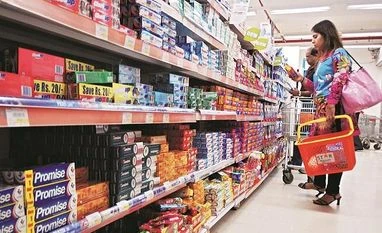
Modern trade, which constitutes 9 per cent of sales for fast-moving consumer goods (FMCG) companies, contracted 8.3 per cent in the March quarter, 2.3 per cent in the December quarter, and 15.2 per cent in the September quarter. The channel remains stronger in urban areas than rural markets.
But, as consumption in metros begins to improve, the negative trend for modern trade could change in the months ahead, Nielsen said. “Metros have seen a consumption uptick, growing 2.2 per cent in the March quarter after two quarters of sequential decline,” Diptanshu Ray, South Asia Lead, NielsenIQ, said.
Gradual easing of restrictions in the metros could aid growth of modern trade, he said, though manufacturers and retailers would need to plan assortments and the interplay of channels, especially the growth of e-commerce when pushing sales.
Retailers are responding to this trend. When announcing its March quarter results recently, Reliance Retail, the country’s largest organised retailer, said it had seen a threefold growth in kirana partnerships on JioMart, its new commerce platform. This had aided its grocery business, since digital adoption was growing among consumers.
Reach of the kirana partnership programme, Reliance Retail said, had been extended to 10 cities, which would be taken to 33 cities in the months ahead.
Avenue Supermarts, which runs the DMart chain of stores in the country, said its e-commerce business had increased its presence across the Mumbai Metropolitan Region and that it had commenced online operations in four new cities, including Ahmedabad, Pune, Bengaluru, and Hyderabad. More cities would be added in the coming quarters.
Future Group, which runs the Big Bazaar chain of stores, had begun its rapid home-delivery service in few cities, promising to deliver goods in two hours. Plans included scaling up the initiative fast.
Sanjiv Mehta, chairman and managing director of Hindustan Unilever (HUL), said modern trade outlets had fine-tuned their business models over time, despite challenges posed by Covid-19.
“Going to a modern trade store is an experience for a middle-class family. It goes beyond shopping. It is an outing. So modern trade will co-exist with other forms of retail in the country, though some large-format stores may shut due to extended closures and high rentals,” he said.
A report by the Boston Consulting Group said India’s retail market, pegged at Rs 125 trillion, would triple by 2030, though there could be a lag of 1-2 years induced by the pandemic. Growth would be led by online and offline retail, including kiranas and modern trade, though digital adoption was growing fast, forcing offline players to innovate quickly.

 "Modern trade to recover as Covid-19 pandemic graph slows: Nielsen")











