A year after the Bajaj Chetak electric scooter (e-scooter) went on sale, Rajiv Bajaj, managing director at Bajaj Auto, is thrilled that the model has attracted ‘all kinds of buyers, including very affluent ones, who have never owned a two-wheeler and are waiting to buy the model’.
Its success, he said, can be put down to performance, the classic styling and features, and an effective branding strategy.
Named after the legendary horse of Maharana Pratap Singh, the e-scooter was given totally differentiated branding and delinked from the broader Bajaj brand in both product communication and in retail. “We wanted Chetak to be identified with electric,” said Bajaj.
Encouraged by consumer acceptance, Bajaj Auto plans to hike the Chetak’s ex-showroom price by Rs 25,000 to Rs 1.5 lakh when the bookings reopen in a few months.
Bajaj concedes, however, that the company has yet to capitalise on the euphoria the Chetak brand has generated. It has managed to sell only 1,000 units and has yet to deliver to 1,500 customers who booked the model after it went on sale in January 2020.
Barely a month after the launch, the outbreak of Covid-19 threw a spanner in the works by throttling the supply of key aggregates.
Meanwhile, competition from Ather and its 450X Smart Electric Super Scooter has been growing. Earlier this month, Ather entered Mumbai (closer to Bajaj’s home turf) with an ‘experience centre’. It also launched a special edition of its flagship 450X scooter.
“Bajaj Auto could be late to the party if it doesn’t act fast,” said an analyst who pointed to Ather’s popularity growing in leaps and bounds. Ather has expanded its presence from an initial nine cities in 2020 to 24.
If all goes well on the supply front, Bajaj plans to reach 500 units a month and then double it to 1,000 units. But even when the volumes reach 2,000 units per month, the company will still lose money on each unit it sells.
Bajaj is unflustered about this and says he has a clear, well-defined road map to profitability for the Chetak. “Whether it’s a new product or new market, it takes time,” he said.
As an example, he cited the case of the company’s flagship Pulsar scooter which wasn’t profitable initially but is a pillar of profitability.
Similarly, when Bajaj started exports to Nigeria in 2003, it was losing $150 per motorcycle. In fact, exports to Africa as a whole were at a loss earlier but are now a margin driver.
“Hitting an earnings before interest, tax, depreciation, and amortisation of 20 per cent wouldn’t have been possible without that,” said Bajaj.
India sold a total of 156,000 electric vehicles in 2020 — 20 per cent higher than a year earlier. Of these sales, close to 78 per cent were electric two-wheelers. The greater ease in running e-scooters, coupled with the demand incentives offered by the government, has made the segment attractive for manufacturers.
Consulting firm KPMG expects electric two-wheelers to account for 25-30 per cent of total two-wheeler sales by 2030.

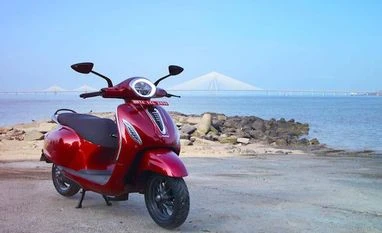 "Created an object of desire with e-scooter Chetak, says Rajiv Bajaj")











