One of the original faces of the Paribartan Chai campaign that ushered in Mamata Banerjee to lead West Bengal, writer and social activist Mahasweta Devi, 91, died in Kolkata on Thursday.
Banerjee, who is in Delhi, is cutting her trip short by a day, and will be back in the city on Thursday. “India has lost a great writer. Bengal has lost a glorious mother. I have lost a personal guide, Mahasweta Di rest in peace,” Banerjee tweeted.
Mahasweta Devi’s alignment with Banerjee happened when the land agitation movements in Nandigram and Singur were at its peak. But, as the writer had clarified many times, the support was not for an individual, but a cause. Indeed. Mahasweta Devi has fought for tribal rights and many such other causes for more than four decades. It was hence only natural for her to join the Bengal intelligentsia when it took the onus of changing the government after a state police firing in Nandigram, which killed 14 people in 2007.
Not one to mince words when situations demanded, Mahasweta Devi was the first to express her disillusionment with the regime change that she had fought for when the police denied the Association for Protection of Domestic Rights (APDR) permission to hold a protest rally against government action in Lalgarh at the Metro Channel in the central business district of Dalhousie. The APDR and Banerjee had fought on the same side in the Rizwanur Rahman case (in 2007) when a young computer graphics teacher had died under suspicious circumstances.
In a way, Nandigram, Lalgarh and Singur are just extensions of all that Mahasweta Devi had stood for all her life. Long before these movements, she voiced her concerns about the commercialisation of Santiniketan, where she had done her graduation. She was a supporter of Budhan Theatre, the theatre group of Chhara — the denotified tribes of Gujarat. The fighting spirit was probably a reflection of the times and environment in which she grew up. Born in 1926 in Dhaka, Bangladesh, Mahasweta Devi moved to Bengal after the partition of India.
Her father, Manish Ghatak (whose younger brother was filmmaker Ritwik Ghatak), was a well-known poet and novelist. Mother, Dharitri Devi, was also a writer and social worker. Mahasweta Devi’s son, Nabarun Bhattacharya, also a writer, died in 2014.
In 1997, Mahasweta Devi, won the Magsaysay award for journalism, literature and creative communication. Among her notable works were Aranyer Adhikar, for which she bagged the Sahitya Akademi Award, and Hajar Churashir Ma.

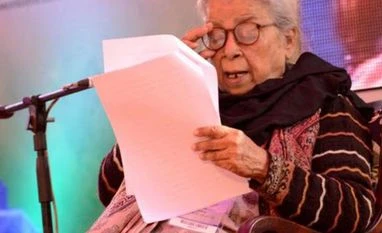 "Mahasweta Devi: A writer who never minced her words")


 Connect with us on WhatsApp