The wailing siren of ambulances tears through the streets of Pune. They carry the sick to the fast-filling hospitals in the city, which is now the worst affected in the country in the second wave of the Covid-19 pandemic. The number of infected and those who need hospitalisation is mounting every day.
Pune recorded 4,426 new cases on March 28. With its population of 3.1 million, this translates to 1,500 cases per million in a day. (The number of Covid deaths in Pune city has hovered between 25 and 30 for the last few days.) The spread of the disease in Mumbai — 7000 daily cases or 600 cases per million per day — pales in comparison. At the time of writing this report, there was only one hospital bed with a ventilator available in Pune.
This, despite the fact the speed of vaccination in the city, which has immunised 10 per cent of its population, has reportedly been faster than that in Mumbai.
With the number of cases skyrocketing, containment measures are being adopted aggressively. But the strategy for containment has changed from last year. While earlier, entire localities were sealed, this time around, specific buildings or housing societies with cases are being notified as containment zones. From zero just a month ago, the number of containment zones has now shot up to 237.
“If we have more than five Covid-19 infected people in a building, or more than 20 cases in a housing society, we declare them a micro containment zone,” says Ganesh Sonune, assistant municipal commissioner, Bibwewadi ward, Pune Municipal Corporation (PMC).
Mahesh cooperative housing society, a group of 80-odd buildings in Bibwewadi ward, was declared a micro-containment zone on March 15. But there is no sign of anything else unusual about the area. The shops and tea sellers outside the housing society do their business as usual.
Many are not even aware that there is a containment zone nearby. Pravesh, who runs a medical shop in the area, says, “Everyone is following the 7AM to 8PM routine, that’s it. But we stay open till 10PM,” he says. Last week, non-essential establishments were told to shut down at 8 pm, instead of the earlier directive of 11 pm.
Municipal officials say these strategies were adopted to make sure that economic activity does not get affected.
Pune is also trying to ramp up its vaccination drive, which is one of the most effective weapons to check the spread of the pandemic. The city has vaccinated 10 per cent of its population, and more than 310,000 people have taken at least one dose of the vaccine.
But the vaccination effort faces two hurdles: that of demand as well as supply.
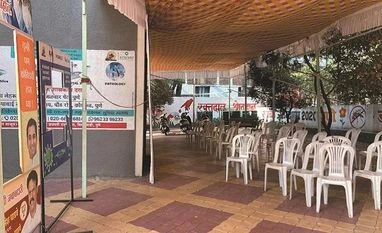
The Yugpurush Chhatrapati Shivaji vaccination centre is nearly deserted in the post-lunch session on the day of Holi. “We had a full house in the morning session, but not many people have come in the afternoon due to Holi,” says Sumit Meshram, the representative doctor at the municipality-run medical centre.
The centre vaccinated 146 people that day, compared to 200 on an average on other days in March.
There is some degree of vaccine hesitancy among people, too. The fear of side effects also keeps many from coming forward to take the shot, says Dr Aditya Phadke, who oversees vaccination at Premchand Oswal Hospital, another municipal vaccination centre in Pune.
“I have been trying to educate those who are coming in, so they can communicate the message to their friends and neighbours when they go back,” he told Business Standard.
Municipal officials say that they are making sure that all available vials are used up at each vaccination centre.
“Our capacity to vaccinate, including that in private hospitals, is quite substantial. For example, Deenanath Mangeshkar Hospital can vaccinate 1,000 people a day, Kamala Nehru Hospital can do 1,100. But the availability of vaccines is not up to that mark,” says Vaishali Jadhav, assistant medical officer, PMC, told Business Standard.
Jadhav says that vaccines are being supplied once in three to four days, but the city needs much more.
Meanwhile, the pandemic is raging. For the Pune district as a whole, which has a considerable rural population as well, the second wave has been worse than the first. While the daily caseload went from 400 to 6,000 in 86 days in 2020, it has gone up from 400 to more than 8,000 in less than 50 days this time.
No one knows when the cases will start declining.