The evacuation: How India is bringing its students home from Ukraine

Despite reassurances (and the announcement that briefings would be held daily), anxiety and panic are bubbling up
Ukraine
Aditi PhadnisAneesh Phadnis New Delhi/Mumbai
6 min read Last Updated : Mar 01 2022 | 6:02 AM IST
Four top ministers were dispatched on Monday as India’s special envoys to countries neighbouring Ukraine to facilitate and speed up the evacuation of Ind­ian students from the war-torn nat­ion. And all stranded Indians were advised to move to West Ukraine but not reach the border directly.

“It is cold. There are long queues at all borders as Ukrainian citizens also make their way to the most convenient exit point. All Indians sho­uld reach cities in west Ukraine and wait in sheltered areas. They should contact the embassy or the helpline. They should not land up at the border where they might have to face a long wait without food or shelter before they are processed,” spokesman for the Ministry of External Affairs (MEA) Arindam Bagchi said.

This explains the complexity of the evacuation of Indians, mostly students, from Ukraine. The govern­ment announced petroleum minis­ter Hardeep Puri would go to Hun­gary; aviation minister Jyotiraditya Scindia to Romania and Moldova; law minister Kieran Rijiju to Slovakia; and MoS for civil aviation and road transport & highways V K Singh to Poland. Bagchi said their main role would be “coordination and local government contact”.

The most convenient exit point is the Ukraine-Russia border, just 70 km away from the main cities of Kharkiv and Kyiv. But the problems here are obvious: till yesterday, bitter fighting was going on and there was a weekend curfew as civilians were advised that Russian “saboteurs” had landed in town and anyone seen on the street would be shot. But the curfew has now been lifted and Bagchi said while fighting was still going on, exit from the Russia border was not an option and all In­d­ians must move west-wards.


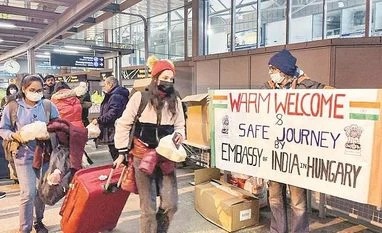
The border points with Romania, Hungary and Poland are on the west. And now that tra­i­ns are running free of ch­­arge from Kyiv, Bag­chi said all Indians must try to move out. “Over 8,000 Indians left since we started issuing advis­o­ries in mid-February. The sixth evac­u­ation flight (four from Buch­arest, two from Budapest) landed in India earlier today. So far, 1,396 stud­e­n­t­s­/Indian citizens have been bro­ug­ht out of Ukraine since Operation Gan­ga (the evacuation) began” Bag­chi said. The MEA control room has so far answered 8,000 calls and 6,000 em­ails. Over the next 24 ho­u­rs, three more flights are scheduled from Bucharest to Mumbai and Delhi.

“Flights are not a constraint. We will add flights when there is demand. On­ce you cross the Ukr­a­ine border, we will bri­ng you back,” Bag­chi said, addressing Indians in Ukraine.

The government is doing all it can in terms of logistics: 10 buses are waiting to take students stuck on the Poland border into the country so that they can be put on flights home. Arran­g­ements for food and accommodation have been made at Rzeszow in Poland. But the border “is pretty crowded”. Similar arrangements, Bagchi said, have been made at Ro­m­ania. Even more complicated is getting out from Ukraine into Moldova, which is land-locked, and thence to Romania where Indians can then be put on flights back from capital, Bucharest. Another option is for students to come out of Ukraine via Uzhgorod in the far southwest, to Hungary.

Some problems can be anticipat­ed. But some are unexpected. For instance, the airport in Slovakia is too small to handle a large number of aircraft. Airspace in some neighbouring countries is closed, so costs of commercial flights are sky high. However, India is conducting all op­erations for its citizens free of cost. The Indian embassy in Romania iss­ued an advisory that if Indians were being asked for money for evacuation, they should not pay as the government was paying for everything.

Bagchi conceded that it was Indians in Kharkiv who were facing the biggest problem — and the government had no assessment of exactly how many Indians were still in the city. “Earlier, we had a sense of the numbers based on registrations. But people are moving and the numbers are dynamic. Once we are able to reduce the total numbers (of evacuees), we will have a better idea. But we do know that Indians are not centred in Kharkiv:  and now that curfew is lifted, the number will be still fewer. Once we know which point they’ve reached, we will be able to get them out to safety.”

Despite reassurances (and the announcement that briefings would be held daily), anxiety and panic are bubbling up. “My cousin Sahil Aneja has been waiting to cross the Polish border for the last three days. Now we have lost all communication with him. We just hope it is because of the mobile battery draining out. He and his friends started out towards the border on advice of the Indian embassy and got stuck,” said Delhi resident Mansi Taneja.


Betsy James, a fifth-year medical student and resident of Kerala, was one of the lucky ones. She was am­ong the 219 students of the Bukov­inian State Medical University who flew on the first evacuation flight from Bucharest on Saturday. The varsity is in the town of Chern­i­vtsi in west Ukraine, close to the Roma­n­ian border. It was a terri­fying time, she said. “On the evening of the invasion, the university hostel asked students to confine themselves to their rooms. Our education agent was in contact with us throughout and on the same day we were asked to pack our belongings. The Indian Student Society, too, helped in coordination. The morning after the inv­asion we were asked to fill up a form for evacuation and by noon we were asked to assemble outside the hostel to catch buses that would take us to the Romanian border,” she said.

“We started out at around 2 pm. There was a police escort in front and behind our bus. We reached the border in an hour and were greeted by officials from the Indian embassy on the other side. We felt so safe and relieved to cross the border. The officials told us not to worry and said we would reach India soon,” James recounted. The students were then driven in a bus to Bucharest airport, a journey of 8-9 hours, and flown to Mumbai on an Air India flight.

Cabinet Secretary Rajiv Gauba on Monday spoke to chief secretar­ies of states and briefed them about the central government’s efforts to bring back students from Ukraine. He has also requested the district co­llectors to contact the families of students and to keep them infor­m­ed of arrangements being made.

One subscription. Two world-class reads.

Already subscribed? Log in

Subscribe to read the full story →
*Subscribe to Business Standard digital and get complimentary access to The New York Times

Smart Quarterly

₹900

3 Months

₹300/Month

SAVE 25%

Smart Essential

₹2,700

1 Year

₹225/Month

SAVE 46%
*Complimentary New York Times access for the 2nd year will be given after 12 months

Super Saver

₹3,900

2 Years

₹162/Month

Subscribe

Renews automatically, cancel anytime

Here’s what’s included in our digital subscription plans

Exclusive premium stories online

  • Over 30 premium stories daily, handpicked by our editors

Complimentary Access to The New York Times

  • News, Games, Cooking, Audio, Wirecutter & The Athletic

Business Standard Epaper

  • Digital replica of our daily newspaper — with options to read, save, and share

Curated Newsletters

  • Insights on markets, finance, politics, tech, and more delivered to your inbox

Market Analysis & Investment Insights

  • In-depth market analysis & insights with access to The Smart Investor

Archives

  • Repository of articles and publications dating back to 1997

Ad-free Reading

  • Uninterrupted reading experience with no advertisements

Seamless Access Across All Devices

  • Access Business Standard across devices — mobile, tablet, or PC, via web or app

Topics :Russia Ukraine ConflictUkraine

Next Story



