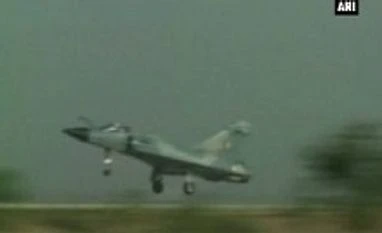
The Indian Air Force landed a Mirage 2000 fighter aircraft on the Yamuna Expressway near Mathura today at around 6:40 a.m. It was the first trial to use a national highway as an emergency landing strip. The IAF plans to activate more such strips in the future.
The use of highways as airstrips is not a new phenomenon. It started during the second world war in Germany where the Autobahn was used to land fighter planes. The Reichsautobahn system was constructed during Hitler’s reign in Germany as a measure to reduce unemployment. The use of motorways as landing strips was not just restricted to Germany, though. As part of strategy, across Europe on both sides of the iron curtain during the cold war, parts of highways were marked as landing strips for aircraft. Russia, Czechoslovakia, Poland, Sweden, Finland Switzerland are countries where highway landing strips were built.
The use of highway strips for landing is an emergency measure to be used when the use of airbases is not available during wartime. The Six-Day war between Israel and Egypt in 1967 offers a prime example of when highways will be useful as landing strips. In one of the most successful air force operations in military history, Israeli Air Force took the Egyptians by surprise and destroyed 18 airfields in a surprise attack in the early morning on June 5, 1967 as part of Operation Focus. Israel achieved complete air superiority over the battle space which would not have been the case had Egypt prepared for alternative landing strips on highways.
The IAF successfully landed a Mirage fighter plane on the Yamuna Expressway on May 21, 2015
The US has also had a popular urban myth surrounding highway airstrips according to which “the Eisenhower Interstate Highway System requires that one mile in every five must be straight. These straight sections are usable as airstrips in times of war or other emergencies.” There is no factual basis to this statement and it originated in 1943 when in a presentation to the American Association of State Highway Officials, Commissioner of Public Roads Thomas H. MacDonald mentioned flight strips. The US Congress considered its inclusion in Federal-Aid Highway Act of 1944 but eventually didn’t.
These strips are usually 2-3.5 km long portions made of concrete with minimal space in the middle of the two sides of the roads. The middle barriers are quickly removed to provide access to the entire strips to the planes. The portions are then swept to remove any debris. At the Yamuna Expressway, the IAF even had bird clearance parties in place before the landing. The Indian Air Force has tried this for the first time in India. The Pakistan Air Force too has used the M1 and M2 Motorways. In 2010 the PAF landed its Mirage on the M2 motorway that connects Lahore and Islamabad.
Highway airstrips are not just used for military purposes though. In Australia, the Royal Flying Doctor Service also uses such strips for its operations.

 "What IAF's Mirage highway landing signifies")


 Connect with us on WhatsApp