37% districts short of rain despite 'normal' monsoon
Abhishek Waghmare | Indiaspend.org After two consecutive droughts, India received normal rainfall - two per cent less than the 100-year average - by the end of August 2016, but within that normality, more than a third of the country is short of rain, according to India Meteorological Department (IMD) data.
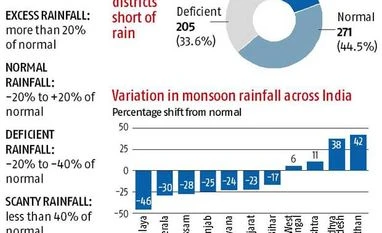
In 610 of 641 districts for which data are available, 389 districts received normal or excess rain, while 221 received "deficient" or "scanty" rain in the first three months of the four-month-long monsoon season. This means September rainfall will now be important to make up for these widespread deficits.
Still, these are best rains since 2013, when India received 14 per cent more than the average rainfall of the June-August period. As much as 16 per cent of the country's area is now rain deficient, according to IMD data.
The sowing of kharif (summer monsoon) crop was five per cent more than normal by August-end because more than half of India's districts received normal rain.
The monsoon deficit is greatest in Northeast, between 30 and 40 per cent-repeating the situation in 2013-followed by Punjab, Haryana, Gujarat and Kerala, where the deficit is between 20 and 30 per cent of normal. Rajasthan, Madhya Pradesh and Maharashtra have received 20 per cent more rain than normal.
Though the area sown is more than normal, some crops have taken a hit. While 40 per cent more pulses were sown than normal till the end of August, cash crops like sugarcane and cotton were 15 per cent short of normal. Extreme rainfall events in central India, the core of the monsoon system, are increasing and moderate rainfall is decreasing - as a part of complex changes in local and world weather - according to a clutch of Indian and global studies reviewed by IndiaSpend in April 2015.
Over a third of India - 221 of 610 districts - is short of rain in a year when the government's weather agency, the IMD, and private weather agencies, such as Skymet and Weather Risk Management Services, and international monitoring agencies, such as the European Centre for Medium-Range Weather Forecasts and the International Research Institute for Climate and Society, USA, had predicted an above-normal monsoon for 2016. The three monsoon months of 2016 bettered the three deficit years of 2012, 2014 and 2015 but lagged 2011 and 2013, which were normal monsoon years, with respect to the proportion of districts facing rain shortfalls. Rains were scarce in a fourth of districts in 2011 and 2013, a third of districts in 2016 and half of India's districts in 2012 and 2014.
The normal sowing area in India till August-end is 97 million hectares, against which 102 million hectares has been sown for the 2016 kharif season. Sown area by the end of the kharif sowing season is 106 million hectares, achieved normally by the first week of September. Irregular rainfall in the cotton-belts of Maharashtra and deficient rains in Gujarat has resulted in less-than-normal sowing of cotton. The sowing of soyabean, a relatively new entrant on farms, is growing. The area under soyabean in Maharashtra was 3.9 million hectares, 0.5 million above the average of 3.4 million hectares, as of August-end.
"The cost of cultivation for cotton is high, and has risen especially after 2008-09," Ayaz Khan, a soyabean and tur cultivator from Vidarbha region in Maharashtra told IndiaSpend. Unirrigated cotton produces a fourth to a fifth of the yield of irrigated cotton; 200 to 300 kg per acre against 1,000 kg per acre, said Khan. "Soyabean gives you assured output in less than three months without irrigation. Further, tur and soyabean require less human effort to cultivate."
Reprinted with permission from IndiaSpend.org, a data-driven and public interest journalism non-profit organisation

 "37% districts short of rain despite 'normal' monsoon")


 Connect with us on WhatsApp