'Make in India' campaign: Private shipyards play second fiddle to DPSUs

Goa shipyard supplies first patrol vessel, but L&T has better record
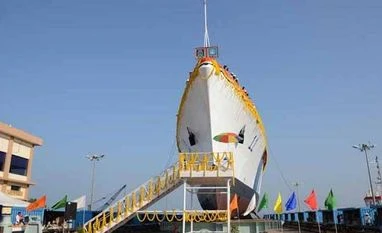
Goa Shipyard
Naval industry analysts say the comparison is valid because the L&T and GSL OPVs are very similar in size and performance
Ajai Shukla New Delhi
4 min read Last Updated : May 23 2020 | 10:12 AM IST

Don't want to miss the best from Business Standard?

With Defence Minister Rajnath Singh commissioning three new ships on Friday, the Indian Coast Guard (ICG) — the world’s fourth largest —crossed the landmark of 150 ships, most of them built indigenously.

The vessels, commissioned in Goa via video conferencing from Delhi, included the Indian Coast Guard Ship (ICGS) Sachet, designed and built by Goa Shipyard (GSL). In addition, Singh commissioned two fast interceptor boats (IBs), built by Larsen & Toubro (L&T) at its Hazira Shipyard. 

“Despite challenges such as Covid-19, it is a great example of our commitment and determination for the safety and security of the country…  It is noteworthy that Indian shipyards are making significant contribution to the vision of Make in India’ and ‘Self-reliant India’ campaign which was recently inspired by our prime minister,” said Singh.
Yet a comparative analysis of ongoing OPV manufacture by GSL and L&T reveals that the private sector firm has delivered clearly better outcomes than the defence public sector undertaking (DPSU).

 In terms of cost, L&T has charged the ICG an average of Rs 187 crore for each of the seven OPVs it contracted in 2015 to build at its new shipyard at Katupalli, near Chennai in Tamil Nadu. 

In contrast, GSL is charging the ICG about Rs 320 crore for each of the five OPVs it contracted to build in 2016 — more than 60 per cent costlier. In terms of build time, GSL has taken four years to deliver the first OPV. In contrast, L&T will have taken just five years to deliver its sixth OPV later this year. The seventh and final OPV will be delivered next year, within six years of inking the contract. Each of these OPVs has been delivered ahead of schedule.

Naval industry analysts say the comparison is valid because the L&T and GSL OPVs are very similar in size and performance. Both are almost the same size: GSL’s OPVs displace 2,350 tonnes, compared to the 2,140 tonnes displaced by L&T’s ship.

In terms of performance, the OPVs built by L&T have a maximum speed of 26 knots and an operating endurance of 5,000 nautical miles. The OPVs built by GSL are slower at 23 knots, but have slightly longer sea legs with an endurance of 6,000 nautical miles.

The only significant capability advantage the GSL vessels have over the L&T OPVs is the fitment of three weapons on each — one 30-millimetre (mm) gun and two 12.7 mm guns — to engage hostile targets. While GSL is supplying OPVs with these guns fitted, L&T is contractually required to kit the OPVs to fit these guns later. However the cost of all three guns is below Rs 10 crore.
Notwithstanding its demonstrated capability, which includes building the hulls of India’s nuclear missile submarines, L&T finds it hard to compete against the four public sector shipyards — GSL, Mazagon Dock, Garden Reach Shipbuilders and Engineers and Hindustan Shipyard. That is because the DPSU yards are handed over contracts on “nomination basis” by the Ministry of Defence, especially for building bigger naval warships such as corvettes, frigates, and destroyers.

Those large contracts allow the DPSU shipyards to cross-subsidise low bids in competitive tenders where private sector shipyards are permitted.

Even so, private shipbuilders, especially L&T, have begun scoring in competitive contracts, such as the Rs 750-crore contract to design and build 12 Fast Patrol Vessels for the Vietnam Border Guard. Despite Covid-19-related delays, L&T is well ahead of schedule in construction. Having sunk over Rs 3,500 crore into building its Katupalli shipyard, the stakes are high for L&T in the first major warship contract the private sector has been allowed into: The Rs 13,600-crore contract to build six New Generation Missile Vessels (NGMVs).
Enable GingerCannot connect to Ginger Check your internet connection
or reload the browserDisable in this text fieldEditEdit in GingerEdit in Ginger×

One subscription. Two world-class reads.

Already subscribed? Log in

Subscribe to read the full story →
*Subscribe to Business Standard digital and get complimentary access to The New York Times

Smart Quarterly

₹900

3 Months

₹300/Month

SAVE 25%

Smart Essential

₹2,700

1 Year

₹225/Month

SAVE 46%
*Complimentary New York Times access for the 2nd year will be given after 12 months

Super Saver

₹3,900

2 Years

₹162/Month

Subscribe

Renews automatically, cancel anytime

Here’s what’s included in our digital subscription plans

Exclusive premium stories online

  • Over 30 premium stories daily, handpicked by our editors

Complimentary Access to The New York Times

  • News, Games, Cooking, Audio, Wirecutter & The Athletic

Business Standard Epaper

  • Digital replica of our daily newspaper — with options to read, save, and share

Curated Newsletters

  • Insights on markets, finance, politics, tech, and more delivered to your inbox

Market Analysis & Investment Insights

  • In-depth market analysis & insights with access to The Smart Investor

Archives

  • Repository of articles and publications dating back to 1997

Ad-free Reading

  • Uninterrupted reading experience with no advertisements

Seamless Access Across All Devices

  • Access Business Standard across devices — mobile, tablet, or PC, via web or app

Topics :Indian NavyPM Narendra ModiMake in IndiaRajnath SinghIndian coast guard

Next Story



