With huge screens and super commuters monitoring every PGCIL line in the country and remote units ready to zoom into any substation, alarm bells ring if there is any issue with the health of the system, giving the feel of a sci-fi movie.
In all 192 locations with nine control centres across India, of which seven are regional and two at the national level, are connected. The plan is to connect 219 locations besides future capacity. In two years, Renewable Management Centres (REMCs) to manage Green Energy Corridors (GEC) would also feed into NTAMC.
PGCIL is readying other plans, too. “It’s not that the record capacity addition that would be the game changer, it would be transmission. A country’s grid should stand the test of time and technology. Among the major driving forces for transmission would be a continued thrust on seamless and flexible grid interconnection,” said I S Jha, chairman and managing director, PGCIL.
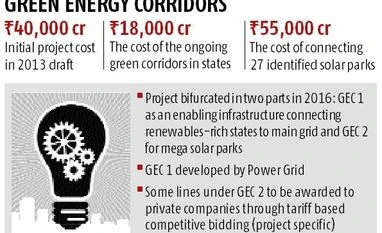
For the next three years, PGCIL has a plan to invest Rs 91,000 crore including the ambitious GEC that has an initial estimated cost of Rs 40,000 crore. GEC, an alternative transmission network to evacuate and blend renewables in the national grid, was designed in 2011. The earlier envisaged investment in the project is likely to increase manifold after the target for renewable energy has been increased five times by the current BJP government.
GEC is under construction in the renewables-rich states of Rajasthan, Gujarat and Tamil Nadu. The projects have been expedited in locations where solar parks with more than 500 Mw capacity are coming up, such as in Rajasthan, Andhra Pradesh and Madhya Pradesh. MP is luring generators by offering seamless transmission in and around the state and waiving off charges for the same. As the wind projects have been bid, PGCIL would also expedite work in west and south India to evacuate wind power to non-windy states in the north.
R N Nayak, former chairman and managing director, PGCIL, who piloted the GEC project, said both demand and supply need to be flexible to secure the grid. “The Indian power system needs to be equipped with a quick start and stop as well as low technical minimum operation of generating plants,” said Nayak.
To enable the same, PGCIL has embarked on Real Time Dynamic State Measurement. In order to have better supervision and control of Indian electricity grid, nationwide installation of phasor measurement units (PMU) has been initiated through Unified Real Time Dynamic State Measurement (URTDSM) programme.
The plan is to instal PMUs at close to 1,300 locations in the first phase, of which 1,000 have been installed. In the second phase, 500 PMUs will be installed along with a network of Optical Ground Wire for facilitating communication services along the transmission network. This will improve grid reliability, reduce probability of blackouts and minimise the impact of grid curtailment. It will also pave way for remote communication and management of power supply till the consumer’s end.
This story has been published with support from WWF-India Young Climate Fellowship Program 2017

 "Power transmission to catalyse climate change goals")












 Connect with us on WhatsApp