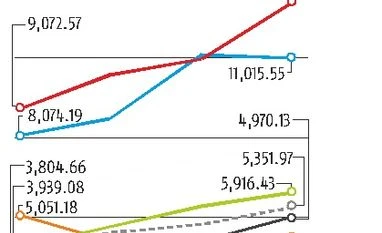
It is not a statistical jugglery that comes from a low base effect. The expenditure was over 3 per cent of the total government spend to begin with, which means it is higher than the paisa going to subsidies like food. In comparison with priorities such as health or education budgets the difference is even more startling. From that high base, there has been a further steep rise in government money spent to finance the expansion of police force. Both the Unite Progressive Alliance and the current governments has carried on with the trend.
Money deployed on policing by the Centre has consistently outpaced that of any of the big-ticket spending items of the government (see chart). Neither has defence or pay out of interest grown so consistently year-on-year. The scale of growth for police is in double digit in all the years. The only exception is the current financial year, but here too the numbers, as of now, are only Budget Estimates. The actual expenditure in most years has over shot them.
“It is costly, no doubt”, says Rathin Roy, director, National Institute of Public Finance and Policy. He pointed to the increasing use of para military forces in this mix. They cost far more than a state government kilted policeman, he said. Per head expenditure on each of these forces is higher than what states spend on their uniformed staff.
The final reason is that states are not spending adequately on their constabulary. So even though law and order is a state subject it is the Centre which is shouldering the responsibility.
In the past five years, all key states have underspent on their police force (see chart). For some of the largest states like Andhra Pradesh, the budget has dipped in some years. But even others who need a strong police presence because of their turbulent law and order situation, there has been hardly any rise in expenditure for their men in uniform. The gap between even their Revised Estimates, which is shown in the Budget figures, and the actual spending reported by the auditors is embarrassingly wide in most years.
Shakti Sinha, Director of Nehru Memorial
So as each year is throwing up more challenges for the Indian state to handle, the central forces are being requisitioned more often. It happened in the latest round of farmers riots and caste riots, too. To make provision for the costlier police force, the Centre has had to economise in other areas. Roy said that expenditure on police was a revenue one. “With this trend it has become impossible to expect a future where the revenue deficit can be contained near zero”, he said. The latest report on fiscal responsibility submitted to the Centre asks for a cap of 0.8 per cent of GDP cap on revenue deficit. The one way to do it is to cut other revenue expenditure. Since wages, interest and even subsidies are rigid, the axe has to fall on non-plan capital expenditure. The states have used their conservative numbers to keep their revenue math in order. May be, given the changed dynamics of law and order the states and Centre should do their policing math afresh.
One subscription. Two world-class reads.
Already subscribed? Log in
Subscribe to read the full story →
Smart Quarterly
₹900
3 Months
₹300/Month
Smart Essential
₹2,700
1 Year
₹225/Month
Super Saver
₹3,900
2 Years
₹162/Month
Renews automatically, cancel anytime
Here’s what’s included in our digital subscription plans
Exclusive premium stories online
Over 30 premium stories daily, handpicked by our editors


Complimentary Access to The New York Times
News, Games, Cooking, Audio, Wirecutter & The Athletic
Business Standard Epaper
Digital replica of our daily newspaper — with options to read, save, and share


Curated Newsletters
Insights on markets, finance, politics, tech, and more delivered to your inbox
Market Analysis & Investment Insights
In-depth market analysis & insights with access to The Smart Investor


Archives
Repository of articles and publications dating back to 1997
Ad-free Reading
Uninterrupted reading experience with no advertisements


Seamless Access Across All Devices
Access Business Standard across devices — mobile, tablet, or PC, via web or app
)