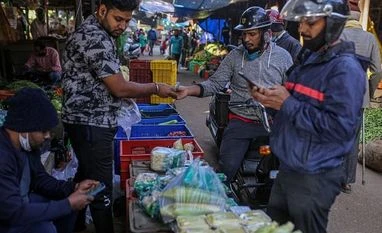
India’s retail inflation rate reversed its three-month downward trend in August, rising to 7 per cent from 6.7 per cent in the previous month, driven by a surge in food prices. This could put pressure on the central bank to further hike policy rates later this month, even though growth in factory output decelerated sharply in July.
The finance ministry said the “moderate” increase in retail inflation was attributable both to an adverse base effect and an increase in food and fuel prices. “Despite erratic monsoons and negative seasonality in vegetable prices, food inflation is still lower than the April peak of the current year. With global inflation pressures, inflationary expectations remain anchored in India with stable core inflation,” it tweeted.
While fuel inflation softened in August to 10.78 per cent due to falling crude oil prices, the prices of cereals (9.6 per cent), fruits (7.4 per cent), vegetables (13.2 per cent), and spices (14.9 per cent) hardened during the month. Among service items, education and household goods and services became more expensive.
Rural inflation (7.15 per cent) continued to be above urban inflation (6.7 per cent) in August.
Among states, inflation in West Bengal (8.9 per cent), Gujarat (8.2 per cent), Telangana (8.1 per cent), and Maharashtra (7.99 per cent) remained above the national average, while it was significantly lower in Delhi (4.2 per cent), Himachal Pradesh (4.9 per cent), and Karnataka (4.98 per cent).
Separately, data released by the National Statistical Office showed that growth in the Index of Industrial Production (IIP) eased to 2.4 per cent in July from 12.7 per cent in the preceding month as mining output (-3.3 per cent) contracted due to monsoon rainfall. Manufacturing and electricity output grew 3.2 per cent and 2.3 per cent, respectively.
Among use-based industries, capital goods, which represents investment demand in the economy, grew 5.8 per cent, while consumer non-durables contracted 2 per cent, signaling worsening demand conditions in rural India.
D K Joshi, chief economist at Crisil, said the sharp slowdown in IIP growth was a result of unfavourable base effect as well as a sequential decline in activity. “The impact of slowing global growth is beginning to be felt by domestic manufacturing. Key export sectors such as textiles, petroleum products, machinery and equipment saw sequential fall in IIP in July. This could gain pace over the next 12 months, as aggressive monetary tightening and elevated inflation hit demand prospects in major advanced economies,” he said.
Sunil Kumar Sinha, principal economist at India Ratings, said the higher cereal inflation in rural areas compared to urban areas since June 2021 is having an adverse impact on rural demand at a time when nominal rural wage growth is lower than rural inflation. “This implies the squeezing of rural household purchasing power, which is getting reflected in the subdued growth in the consumer non-durables segment,” he added.
Finance Minister Nirmala Sitharaman last week said inflation management can’t be singularly left to monetary policy, “which has proved totally ineffective in many countries”, and noted that both fiscal and monetary policies have to work in lockstep to contain the rise in prices.
India’s retail inflation has been above the RBI’s upper tolerance limit of 6 per cent for eight consecutive months. The central bank has already increased the policy rate by 140 basis points to 5.4 per cent in the past four months. The Monetary Policy Committee (MPC) of the RBI is scheduled to meet on September 28-30, with economists expecting yet another interest rate hike.
Aditi Nayar, chief economist at rating agency ICRA, said even though retail inflation may undershoot slightly the 7.1 per cent projection for the July-September quarter by the MPC, she now foresees a higher likelihood that the MPC will stick to the new normal rate hike of 50 bps in its September meeting. “We expect the CPI inflation print to rise slightly to 7.1 per cent in September,” she added.