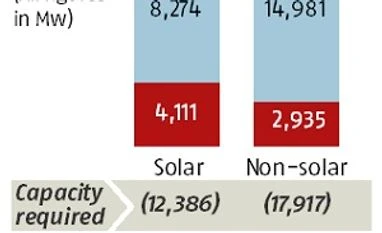
With hardly any state coming forward with a plan to purchase energy from renewable sources, around 8,000 Mw of solar power and 15,000 Mw of non-solar capacity are likely to find no takers by the March-end.
Six months after the central government issued a five-year trajectory for Renewable Purchase Obligations (RPOs), only three states have indicated a plan in this regard. The RPO notification, issued in mid-August by the ministry of power, makes it obligatory for distribution companies, open-access consumers and captive power producers to meet part of their energy needs through such sources.
According to the schedule, 30 states and Union Territories must purchase a combined 8,270 Mw of solar power to meet the solar RPO for 2016-17. However, they’re buying only a third of the target suggested. In the non-solar category, 22 states/UTs require around 15,000 Mw to fulfill the non-solar RPO during 2016-17. “While the rates have fallen to a record (low) of Rs 4 a unit for solar and Rs 5 for wind, it is still costlier than conventional and spot power prices. Also, most states are debt-ridden,” explained a Delhi-based renewable energy (RE) expert.
An RPO trajectory for both non-solar and solar power purchase has been specified from the current year till 2018-19. For non-solar, the targets range from 8.75 per cent to 10.25 per cent of the total power purchased; solar is 2.75-6.75 per cent. The target is to procure RE of at least 17 per cent of the total power purchased by 2019.
States that have issued an RPO trajectory are Andhra Pradesh, Madhya Pradesh and Rajasthan. Andhra Pradesh has surpassed the targets set by the Centre, to indicate a RPO of 25 per cent till 2019. The MP and Rajasthan targets are similar to the one suggested by the Centre.
For this year, barring five states and one UT, none is close to meeting their RPO target. This is the fifth year in a row that full compliance is missing. Eight states have met 60 per cent.
Due to non-compliance with the RPO, the market for RE Certificates (RECs) is also hit. States or utilities that are unable to fulfil their RPO may buy these; an REC represents 1 Mw-hour of power produced from an RE source and can be traded at power exchanges.
RECs are available in both solar and non-solar. According to the ministry of new and renewable energy, there is a huge backlog “due to non-purchase of REC by states to meet the RPO compliance gap”. The total REC inventory till end-December 2016 was 18.58 million (14.35 mn in non-solar and 4.23 mn in solar. The REC market, launched in 2010, had crashed in 2014, with a little more than 10 mn certificates going unsold.

 "States drag feet on renewable power")












 Connect with us on WhatsApp