StatsGuru: India's report card on gender progress
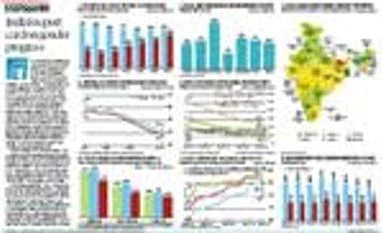
Business Standard The ministry of Statistics and programme Implementation (MoSPI) has released data for to India's progress on gender-related fronts. One major indication of gender progress - or the reverse - is the sex ratio, the number of women per 1,000 men. As Table 1 shows, it has been climbing in urban areas since independence, though it is still below natural levels, which are above 1,000. Rural areas saw a dip and a recovery. It is worth noting that, in 2011, there were significant differences between religions in terms of sex ratios, as Table 2 demonstrates; Christians had close to a natural rate, and Hindus and Sikhs fared worst, while Muslims were in the middle. Table 3 shows which states have improved or worsened their sex ratios since independence. West Bengal, Assam and Delhi are standout performers. Gujarat and Odisha have done poorly - but Bihar and some places in the Northeast have done worst of all.
Table 4 shows infant mortality rates - the number of babies per 1,000 who die before their first birthday - over the past decade. While the decline has been sharp and creditable, the difference between boy and girl babies is notable. The decline in maternal mortality rates - the number of women who die in childbirth, for every 100,000 live births - has not been as pronounced in many states, Table 5 shows.
Total fertility rates (TFRs) - the number of children a woman would typically have - are shown in Table 6. The "replacement" rate, which keeps population constant, is 2.1; it is worth noting that literate women in India have TFRs of 2.1, and urban women and school-leavers are well below 2.1. There is good news in school enrolment; as Table 7 shows, the number of girls in school has risen over the past decade. However, workforce participation for women is still very low - and has been declining in rural India, according to Table 8.

 "StatsGuru: India's report card on gender progress")


 Connect with us on WhatsApp