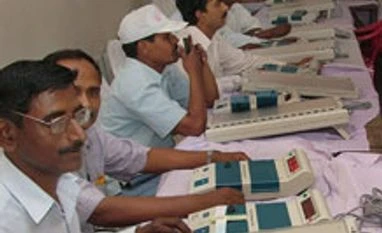
Does high voter turnout suggest an election wave this time?
Mayank Mishra New Delhi Such was the popular resentment against the Indira Gandhi-led Congress in the 1977 Lok Sabha elections that the party managed to win only two out of the 237 seats it contested in Bihar, Uttar Pradesh, Madhya Pradesh, Rajasthan, Punjab, Haryana, Himachal Pradesh and Delhi.
Its success rate — seats won as a percentage of seats contested — fell by a staggering 48 percentage points compared with the 1971 elections and its vote share by nearly 10 percentage points. The party did not win a single seat in Bihar and Uttar Pradesh, two states that had 139 Lok Sabha seats then.
The 1977 Lok Sabha elections were one of three in India’s history that witnessed a wave. The other two were in 1971 and 1984, which had huge positive swings for the Congress. But 1977 was a complete washout for the party.
An 8-10 per cent increase in voter turnout in the first five phases of the 2014 general elections is being seen as the effect
of another wave at work. But data suggest wave elections do not necessarily mean substantially higher turnout.
In the 1971 elections turnout dipped nearly seven percentage points. However, in 1977 the turnout at 60 per cent was five percentage points more than, in 1971. In 1984, too, the turnout was 6.5 percentage points more than that in the previous general elections.
“I would be hesitant to rely on turnout data alone to make any predictions about whether or not this is good news for any particular party,” says Devesh Tiwari of the University of California, San Diego.
Moreover, various voter awareness campaigns by the Election Commission and civil society groups might also have helped.
A K Verma, professor at Christ Church College, Kanpur, said, “I would not like to call the 1984 elections as a wave in the true sense of the term. It was more of a sympathy wave shorn of any political content. But 1971 and 1977 definitely were wave elections, one positive and the other negative. Fresh from the Bangladesh war, there was a sense of euphoria for the Congress in 1971. In 1977, on the other hand, resentment against the excesses of Emergency was so high that people wanted to get rid of the Congress.”
The Congress-led United Progressive Alliance was voted to power in 2009 with a decent majority but is predicted to face a rout, going by numbers thrown by up various opinion polls. Political observers, however, do not see in this a wave for the Bharatiya Janata Party’s prime ministerial candidate Narendra Modi.
Sanjay Kumar, fellow at the Centre for the Study of Developing Societies, said, “A wave ensures a majority for a party. This does not seem to the case this time. Our surveys show that in states where the BJP is strong, people are voting for the party, not just for Modi. However, in states where the party was not so strong, Modi’s appeal seems to be working.”
Sudhir Panwar, professor at Lucknow University, says, “Everybody is talking about Modi because the media is talking about it. The media’s reach has increased manifold since 2009. But once you dig deep you come to know that traditional loyalties towards parties have remained intact.” He has toured many constituencies in Eastern Uttar Pradesh in the last 10 days.
Political observers also say that for elections to turn into waves anti-incumbency has to be really very strong, which is not the case now. “My understanding of the situation in Uttar Pradesh is that the anti- Congress feeling is not very strong here. The Congress is blamed for price rise, corruption and mishandling of foreign relations. None of them seems to have impacted the people who actually go out and vote,” observes Verma. He, however, adds that seemingly popular support for Modi “is not just a media creation, but also a reflection of the situation on the ground. The extent of popular support will be known only after the results are out.”

 "Does high voter turnout suggest an election wave this time?")


