East UP show key to Modi's march to Delhi
While BJP's prime ministerial candidate connected well with masses by raising the right issues, Rahul attacked Modi of being pro-rich
Aditi Phadnis Varanasi In Varanasi, the sun is setting for some. But, as a sadhu says meditatively, it is rising for others. Polling in Varanasi and 40 other seats has ended. This (last) round of the 2014 general elections will be decisive: If the Bharatiya Janata Party (BJP) does not do well in this round, it cannot hope to form the government. If the Congress can beat back challengers, it will have disproved virtually all poll surveys.
Although there were reports that Narendra Modi would be in Varanasi on the day of polling, he sent a recorded message instead. Hardly any imported BJP leaders remain in town. As the sun sets, exhausted party workers return home to rest and prepare for victory celebrations.
At Dashashwamedh Ghat here, there is a hubbub as it gets ready for the Ganga Aarti routine. Till about 15 years ago, this used to be a quiet affair, not “the Parsi theatre it now is”, says Kalyan Krishna, for years a professor of History of Art at Banaras Hindu University, a little disdainfully. The corporatisation of the Ganga aarti followed the “support” for the event from the Taj group when it got a new and dynamic general manager who saw the commercial potential of the ritual.
Earlier, the aarti was performed by priests. Now it is performed by paid worker priests. In the manner of Banarasis, who are used to seeing both sides, Krishna says it is all for the good: Because ghats all across Banaras are now copying the aarti. It brings visitors, some money and a degree of awe...
Money and awe are what Banaras badly need. “Not just Banaras, India needs money and awe,” says Sushant Mishra, 22, a doctorate student at Banaras Hindu University. He says it is stupid to be apologetic about being ambitious. Krishna thinks there is no need to scream and shout about being great. “In historical narrative, there are accounts of merchants travelling from Banaras with 400 bullock carts to places as far away as Afghanistan. But whether you wore a watch costing Rs 5 lakh, or you wore one that was made by HMT, Banaras treated you the same. You came to the ghat, sat and chatted, did the puja at the Ganga and returned home much, much richer.”
Many in Banaras see themselves as a metaphor for India. Chaurasiaji, who sells lassi at the Chauk, says there is much wrong with India. “Phree (free) mein to kucch bhi nahin milta (You get nothing for free),” he says, as the power goes out in his shop. “Lekin jab paisa dete hain to maal bhi milna chahiye (But when you pay money, you should get the commodity).”
“They (the government) keep raising taxes,” says powerloom operator Shahid. “My question is, why don’t we ever get anything for paying these taxes.”
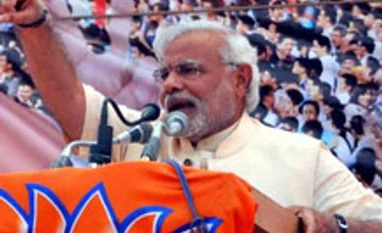
In all his speeches in eastern UP, this is what Modi kept driving home. The dominant of these is: “Did any of you get the jobs the UPA government promised? The house it promised? Did any of your relatives, friends, anyone from your caste, village, community”?
Rahul Gandhi’s riposte to this is: “The BJP only represents the interests of the rich and wealthy. It does not speak for the poor, the dispossessed.”
In Banaras, as in the rest of India, frantic calculation is writ large on every face, as the queues snake into booths and then disappear after casting their vote. Kabir Ahmad is a weaver taking time off during a power cut, enjoying a hot sweet cup of milky tea. “Kaa ho, ungli par tilak lagahin ki nahi (Did you not cast your vote?),” a passerby asks him. He nods and tells Business Standard: “India ko vote diya hai hamne (I have voted for India).”

 "East UP show key to Modi's march to Delhi")


 Connect with us on WhatsApp