Election results 2018: How will BJP defeat in states affect policy making?

For the BJP, the tussle over framing priorities and campaigning planks will continue till the 2019 Lok Sabha elections
elections, polls
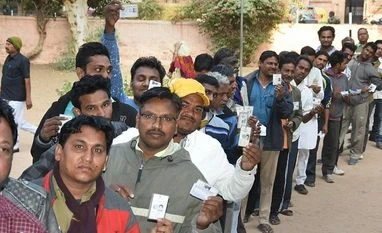
Voters show their identity cards as they stand in a queue at a polling station to cast their vote for the state Assembly elections, in Jodhpur | Photo: PTI
Aditi Phadnis
Last Updated : Dec 11 2018 | 7:45 PM IST
The Narendra Modi led government has faced its biggest state elections defeat ever. How will this impact policy-making in the remaining term of the central government up until 2019? And in the silent tussle for primacy internally within the Sangh Parivar, who are the winners and losers after this result?

ALSO READ: Election results LIVE: Congress stumped out of Mizoram, MNF wins 12 seats
 
First, why is this the worst defeat ever? Because in Gujarat, the Congress kept snapping at the BJP’s heels but despite this the BJP was able to form a government with just a 2 per cent increase in its vote share, (49.1 over 47.9 in 2012). Morever, the BJP lost heavily against its Lok Sabha 2014 vote share tally of the massive 59.1 per cent vote share it got in 2014 Lok Sabha polls. In other words, a slippery slope. 

In Karnataka, the seat tally for a united BJP (in the 2013 elections Yeddyurappa formed his own party and contested against the BJP) was up a massive 104 from 40 it got in 2013. The vote share tally was up from 19.9 per cent to 38 per cent. BUT, this was still much lower than the vote share tally of 43.4 per cent the party got in the Lok Sabha elections. Despite a huge increase in its seat tally, the BJP was unable to form a government. 


So while the earlier elections were setbacks, they also signalled a secular trend. Unless state governments work really, really hard, the BJP stands facing a similar problem in the upcoming state elections which will be held together with the Lok Sabha (Andhra Pradesh, Odisha, Haryana, Maharashtra, Arunachal Pradesh and Sikkim). 

So you could argue that state elections come and go and no one party can expect to win all. That being the case, how will the BJP work towards formulating policy in the remaining period of its rule in the centre and what changes should we expect?


Public spending will increase as a result of the elections outcome. Consider the performance of the TRS government in Telangana. At its most emotive when the Telangana state was formed and won through a TRS-led struggle, the party won just 63 seats in a 117 assembly. Now, after three years, on the back of solid welfare work, the party has swept Telangana. So spending on people helps in winning elections. This has a powerful message for the budget (2019-20).

Opposition unity has not really worked. In Telangana, the much vaunted Mahakutumi of the Telugu Desam Party and the Congress and others has posted a miserable performance. So if opposition unity represents a seamless transfer of opposition votes to a single candidate: well, it doesn’t work.


Within the Sangh Parivar, the Vishva Hindu Parishad (VHP) and the Bajrang Dal will tell the Bharatiya Janata Party (BJP): this is what will happen if you promise the majority you will address their grievances and then don’t do so. In other words, if you don’t build the Ram Mandir via an ordinance, you can see what might happen to you. It is another matter that a VHP-sponsored ‘yatra’ to build the Ram Mandir started from Delhi with just 50 people. 

By contrast, the Narendra Modi government would like to focus to continue to be on its work: but this will now have to be stepped up. Besides, the time for launching new initiatives is now past – there isn’t enough time to formulate and roll out national schemes. Over time, even if there are glitches in the implementation of schemes, people tend to be forgiving of them if there is enough time to iron them out. But that’s the one thing this government doesn’t have any more: time. This tussle over framing priorities and campaigning planks will continue till the 2019 Lok Sabha elections. 


One subscription. Two world-class reads.

Already subscribed? Log in

Subscribe to read the full story →
*Subscribe to Business Standard digital and get complimentary access to The New York Times

Smart Quarterly

₹900

3 Months

₹300/Month

SAVE 25%

Smart Essential

₹2,700

1 Year

₹225/Month

SAVE 46%
*Complimentary New York Times access for the 2nd year will be given after 12 months

Super Saver

₹3,900

2 Years

₹162/Month

Subscribe

Renews automatically, cancel anytime

Here’s what’s included in our digital subscription plans

Exclusive premium stories online

  • Over 30 premium stories daily, handpicked by our editors

Complimentary Access to The New York Times

  • News, Games, Cooking, Audio, Wirecutter & The Athletic

Business Standard Epaper

  • Digital replica of our daily newspaper — with options to read, save, and share

Curated Newsletters

  • Insights on markets, finance, politics, tech, and more delivered to your inbox

Market Analysis & Investment Insights

  • In-depth market analysis & insights with access to The Smart Investor

Archives

  • Repository of articles and publications dating back to 1997

Ad-free Reading

  • Uninterrupted reading experience with no advertisements

Seamless Access Across All Devices

  • Access Business Standard across devices — mobile, tablet, or PC, via web or app

Next Story



