
Markets swing to poll tune in Gujarat and Himachal Pradesh
Benchmark indices swing sharply, recouping initial losses after BJP wins polls in the two states; focus to shift back to earnings, macros
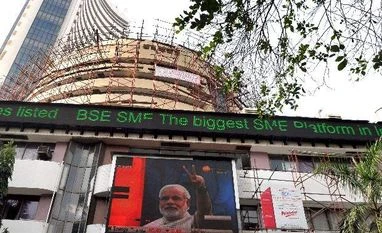 "Markets swing to poll tune in Gujarat and Himachal Pradesh")
premium
Explore Business Standard
Benchmark indices swing sharply, recouping initial losses after BJP wins polls in the two states; focus to shift back to earnings, macros
Indian stock markets gained on Monday after the Narendra Modi-led Bharatiya Janata Party (BJP) won the state elections in Gujarat and Himachal Pradesh. The key benchmark S&P BSE Sensex gained 139 points, or 0.4 per cent to close at 33,601 while the Nifty 50 closed at 10,389, up 55 points or 0.54 per cent.
Sensex had declined as much as 867 points, or 2.6 per cent in the opening hour as some early trends showed Congress in the lead. The index at one point was trading 339 points higher as the BJP started to gain ground. However, the Sensex settled 200 points lower from the day's high as the victory margin was narrower than what the Street had expected.
Following cues from the equity market, bond and rupee markets also witnessed some volatility. The yields on the 10-year bond rose to 7.22 per cent before settling at at 7.18 per cent, from their Friday level of 7.13 per cent. Rupee also witnessed some pressure sliding to day's low of 64.71 amid selling by overseas investors. It closed at 64.23 a dollar, down from its Friday's close of 64.05.
Even the broader markets remained positive with the BSE MidCap and SmallCap indices gaining 0.76 per cent and 0.45 per cent, respectively. The markets on Friday, too, had seen sharp gains after exit polls suggested a BJP win.
Foreign portfolio investors (FPIs) remained net sellers to a tune of Rs 431 crore, while domestic institutions net purchased shares worth Rs 1,076 crore, provisional data showed.
Experts say BJP's victory is positive for the markets as it will help the government to carry on with the reform agenda. The lower-than-expected victory margin in Gujarat is also seen as a wake-up call by some experts. Market participants expect markets' focus in the short-to-medium term to shift back to macro-economic data, corporate earnings growth, pace of reforms and the upcoming Budget in February.
"The poll verdict is a positive development from the market point of view as the central government will now look to push its reforms agenda further helping Indian economy to get on a high-growth path. Other factors such as global markets, inflows into mutual funds and global commodity prices are also and will add steam to the market rally," said Nirmal Jain, chairman, IIFL.
"With the elections now over, the markets will now go back to looking at fundamentals, which I feel are not so great. That said, the liquidity-driven rally may continue for the balance of the year (FY18). Monday morning was a warning sign of what could come if there is some real negative news. There are no fundamentals to hold the markets," said Andrew Holland, chief executive officer, Avendus Capital Alternate Strategies. Over the next one year, the market returns should move in line with earnings growth, say around 15 per cent from here on, he added.
Auto and banking stocks led Monday's rally with shares of Mahindra & Mahindra gaining 2.7 per cent-the most among Sensex components. Wipro, ICICI Bank, Maruti and Asian Paints also gained more than 1.5 per cent each. Shares of state-owned banks also posted impressive gains on the back of government's announcement of additional allotment of Rs 11,000 crore to the bank recapitalisation plan. While the Nifty PSU Bank index closed 2.3 per cent higher, shares of State Bank of India ended two per cent higher.
As the attention shifts to corporate earnings and economic growth in the next few months, several brokerages are also pointing out to green-shoots.
"The earnings in the last one year have been hit by reform measures such as GST. However, the corporate profits are expected to normalise from the December quarter onwards. Things look positive on the economy front as well as economic growth is showing signs of revival. Exports have also rebounded sharply. Overall, the momentum in the markets is expected to continue for the next six months," said UR Bhat, managing director, Dalton Capital Advisors.
Things on the global front also continue to look positive as portfolio investors continue to chase relatively risker emerging markets (EMs) equities. Currently, liquidity conditions remain benign. Even though the US Federal Reserve has embarked on the gradual path of hiking interest rates and tapering its balance sheet, the European Central Bank (ECB) and the Bank of Japan (BoJ) have loose monetary stance.
From the investment perspective, Holland suggests investors steer clear of pharma and power sectors. The information technology (IT) sector is probably seeing the worst times and will take time for the restructuring for the companies in this space to come through, he feels, and remains bullish on private banks, housing finance and the auto sectors. Tirthankar Patnaik, India Strategist at Mizuho Bank suggests investors look at commodity-driven sectors from a year's perspective.
Already subscribed? Log in
Subscribe to read the full story →

3 Months
₹300/Month
1 Year
₹225/Month
2 Years
₹162/Month
Renews automatically, cancel anytime

Over 30 premium stories daily, handpicked by our editors


News, Games, Cooking, Audio, Wirecutter & The Athletic
Digital replica of our daily newspaper — with options to read, save, and share


Insights on markets, finance, politics, tech, and more delivered to your inbox
In-depth market analysis & insights with access to The Smart Investor


Repository of articles and publications dating back to 1997
Uninterrupted reading experience with no advertisements


Access Business Standard across devices — mobile, tablet, or PC, via web or app
First Published: Dec 18 2017 | 11:46 PM IST

