
Boehner resignation cuts US government shutdown risk
Wall Street gears up for a week heavy with economic data and commentary by Federal Reserve policymakers
 "Boehner resignation cuts US government shutdown risk")
WebinarsNew
Deep DiveNew
Explore Business Standard
Wall Street gears up for a week heavy with economic data and commentary by Federal Reserve policymakers
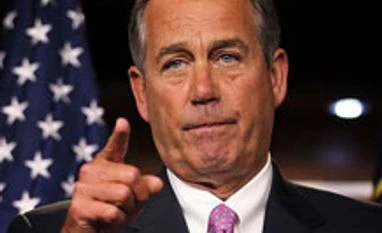
The shock resignation of US House Speaker John Boehner on Friday reduces the chances of a government shutdown next week, potentially removing one source of investor anxiety as Wall Street gears up for a week heavy with economic data and commentary by Federal Reserve policymakers.
Boehner said Friday he will step down from the speakership and leave the House at the end of October. This was seen as a sign that Boehner would advance a bill to fund the government without any complicating factors that would result in a White House veto.
"This significantly reduces the probability of a government shutdown next week," Goldman Sachs economists said in a note to clients on Friday.
While Boehner's resignation makes a government shutdown due to a lack of funding on October 1 less likely, other fiscal challenges remain. A long-term federal budget deal and a debt ceiling increase must still be passed by Congress. Disputes over these issues between the two parties and among Republicans will not be resolved by Boehner's departure.
"The next relevant question for financial markets will be how this affects the debt limit and other pending issues. There is a clear possibility that the vote next week, which was initially expected to deal just with the extension of spending authority, could instead also address other issues like an extension of the Export-Import Bank and, possibly, even an extension of the debt limit," Goldman Sachs' note said.
Removing one area of uncertainty could help calm a US stockmarket in the midst of a correction in the past month as investors grapple with weakening earnings, China's economic woes and uncertainty surrounding US monetary policy.
Recent skittishness among investors could increase the possibility of a negative reaction in markets if a government shutdown is not averted. While the S&P 500 stock index actually rose about 3.0% during the last government shutdown in 2013, the gains occurred during a year when the index rose nearly 30%.
Stocks are already in the midst of a volatile stretch. Since August 20, more than half of the trading sessions have seen moves of at least 1.0% in either direction on the benchmark S&P 500 index.
"As you transition towards the later stages of negotiations, if they can't get to a conclusion or a deal done, then absolutely the markets will take that as a third arrow in the quiver on market volatility and potential downside," said David Lyon, global investment specialist at JP Morgan Private Bank in San Francisco.
Next week's calendar could provide other catalysts for volatility. A host of Fed officials are scheduled to speak, including Federal Reserve Chair Janet Yellen, New York Fed President William Dudley, Chicago President Charles Evans and San Francisco President John Williams.
Investors will also eye reports on US housing and manufacturing, and the week culminates with the September Labor Department payrolls and unemployment report. Forecasts call for job growth of 203,000 versus the prior 173,000, with the unemployment rate expected to hold steady at 5.1%.
First Published: Sep 26 2015 | 6:39 AM IST


 Connect with us on WhatsApp