CEOs counsel taking Trump seriously, but not literally

The stakes are high for companies that have prospered during the era of globalisation
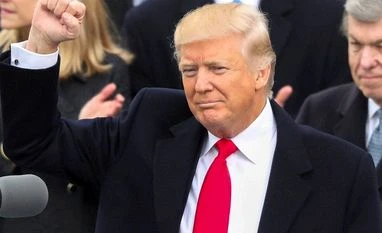
President Trump: A clenched fist for day 1
President-elect Donald Trump pumps his fist as he arrives for his Presidential Inauguration at the US Capitol in Washington Photo: PTI
Thomas BlackMatthew Campbell
Last Updated : Jan 22 2017 | 2:11 AM IST
The word in Davos: ignore the tweets. Executives gathered in the Swiss resort for the World Economic Forum this week keep repeating, like a soothing mantra, that Donald Trump is at heart a pragmatist who will avoid trade wars and regulations that make it harder to do business.

“What somebody’s saying is not necessarily what they’re going to do,” said David Cote, chief executive officer of Honeywell International. He should hope so: Honeywell is a global manufacturing giant with far more employees outside the US than in, and it has made major bets on projects like supplying parts for China’s first commercial jet.

With stock markets nearing record highs and business-friendly figures like billionaire investor Wilbur Ross named to the cabinet, a conviction has set in that a man who came to power as an anti-establishment populist might in fact usher in a golden age for business.

“In the end if he knows the facts, he’ll respond according to the facts,” said Hideaki Omiya, chairman of Mitsubishi Heavy Industries.

The stakes are high for companies that have prospered during the era of globalisation, locating factories where labour’s cheap and finding suppliers that can offer components at the most competitive prices. Trump has criticised the arrangements that make those integrated operations possible, calling the North American Free Trade Agreement — which has allowed automakers like Ford Motor to build supply chains spanning the length of the continent — a “disaster.” During his campaign, Trump blasted the multilateral economic and political order, saying China, the most important US trading partner, had been allowed “to rape our country.”

Companies shouldn’t sweat the president’s “one-liners” and instead should focus on Trump’s cabinet nominees, said Jamie Dimon, CEO of JPMorgan Chase & Co. “I think that these very rational people will be very thoughtful when they go about the actual policy.” 

Foreign companies say they’re similarly relaxed; Nissan Motor’s co-CEO, Hiroto Saikawa, said he doesn’t believe Trump has any intention of severing trade ties that benefit the US.

Some political veterans say the Davos set is being naïve. Larry Summers, a Treasury Secretary under President Bill Clinton, is puzzled by the shifting views on Trump and cautions against “enabling” the new administration.

“I’ve been very troubled by the attitude of business people from the US,” Summers said. “People who were terribly afraid of what this would mean for America’s place in the world are now hailing those who surround Donald Trump as great geniuses.”

Phil Levy, a senior fellow at the Chicago Council on Global Affairs and adviser to former President George W Bush, said executives shouldn’t entirely discount what Trump says. Past presidents, he notes, have been careful to avoid proclamations they don’t intend to stand behind. 

“Usually when somebody who’s been elected president makes threats, people take it seriously,” Levy said.

The health-care industry has a more delicate task than most in making its case to Trump. Earlier this month he accused drugmakers of “getting away with murder” through high prices, and broke with traditional Republican policy by suggesting the government could use its purchasing power to rein in costs. Drugmakers, though, argue they need to charge what they do to reward the risks they face and to cover the cost of research.

One of them, Merck KGaA CEO Stefan Oschmann, said he’s “convinced that the US is a market that values innovation.” Besides, he said, pharmaceutical companies employ thousands of highly paid researchers in cities like Boston and San Diego, “a huge share of the value chain of drug-making.”

Executives looking for ways to avoid confrontation with Trump will try to highlight those arguments, on the assumption that his main concern is US economic growth and employment, rather than ideology. Winning his support may not take much: he took to Twitter to praise Wal-Mart Stores for a “big jobs push back into the US” after the retailer announced 10,000 new positions that in fact represented a slowdown in growth plans compared with previous years.

“This is all about jobs in the US,” said Novartis AG CEO Joe Jimenez. “That will be the True North, and everything else will follow that.”

One subscription. Two world-class reads.

Already subscribed? Log in

Subscribe to read the full story →
*Subscribe to Business Standard digital and get complimentary access to The New York Times

Smart Quarterly

₹900

3 Months

₹300/Month

SAVE 25%

Smart Essential

₹2,700

1 Year

₹225/Month

SAVE 46%
*Complimentary New York Times access for the 2nd year will be given after 12 months

Super Saver

₹3,900

2 Years

₹162/Month

Subscribe

Renews automatically, cancel anytime

Here’s what’s included in our digital subscription plans

Exclusive premium stories online

  • Over 30 premium stories daily, handpicked by our editors

Complimentary Access to The New York Times

  • News, Games, Cooking, Audio, Wirecutter & The Athletic

Business Standard Epaper

  • Digital replica of our daily newspaper — with options to read, save, and share

Curated Newsletters

  • Insights on markets, finance, politics, tech, and more delivered to your inbox

Market Analysis & Investment Insights

  • In-depth market analysis & insights with access to The Smart Investor

Archives

  • Repository of articles and publications dating back to 1997

Ad-free Reading

  • Uninterrupted reading experience with no advertisements

Seamless Access Across All Devices

  • Access Business Standard across devices — mobile, tablet, or PC, via web or app

Next Story



