Ease vs cost of doing business in India

Business index rankings have become a substitute for addressing the fundamental constraints faced by entrepreneurs
ease of doing business, companies, economy, policy, reforms
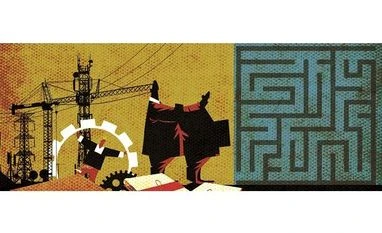
Illustration: Binay Sinha
Ajay Chhibber
6 min read Last Updated : Jul 22 2021 | 12:14 AM IST
India improved its global rank in the World Bank’s Ease of Doing Business Index (EDBI) 79 positions from 142nd in 2014, when the Modi government came to power, to 63rd in 2019. But despite a massive jump in its EDBI rankings, India’s gross domestic product growth (GDP) rate fell more than 4 per cent points between 2016 and 2019 and private investment as a share of GDP fell by over 3 per cent points, from 25 per cent of GDP in 2004-2013 to under 22 per cent of GDP in 2016-2019.    

The problem with EDBI is that it is easy to game it to show better results — without it having much meaningful impact on competitiveness. India was able to attract considerable investment — both domestic and foreign from 2004 to 2013 — even when its EDBI score was low.

Independent reviews show that the EDBI has many flaws, both in what it measures and how they are measured. An index that is built on the principle that less regulation is always better — is downright dangerous — as shown by the experience of the Global Financial Crisis in 2008-09. The EDBI does not include any labour or environmental regulations — quite shocking in today’s world of rising inequality and threats from climate change. It encourages a race to the bottom.

Since many regulations are made and implemented at the state level — India started ranking states on the EDBI. No surprise, then, many states found ways to game the index. UP, for example, with many poor indicators on education, skilled labour, power, roads, and connectivity suddenly jumped to 2nd rank within India in 2019 in the inter-state EDBI.

Despite improvements in its EDBI rank, India’s industry, with some exceptions, is not competitive. India has faced premature de-industrialisation because the costs of doing business are much higher than its competitors. On paper, labour costs appear to be lower in India, but not when you compare it to labour productivity. Only 4 per cent of India’s labour force is classified as skilled. In addition, labour laws encourage firms to stay small — at under 10 employees to avoid a visit by a labour or tax inspector — whose raj runs rampant. More than 70 per cent of manufacturing employment is in firms with size smaller than 10 — which cannot compete globally.

Land acquisition is not only slow but has become prohibitively expensive after the Land Acquisition Act of 2013, which both the United Progressive Alliance and the National Democratic Alliance parties voted for. The Modi government promised to address this issue after coming to power, but so far has not succeeded.

Illustration: Binay Sinha
The costs of capital remain very high because the banking system is awfully inefficient. The spread between lending and deposit rates exceeds 500 basis points (bps) — amongst the highest in the world. India’s banking sector spreads are higher than major competitors —Bangladesh, 350-400 bps; Thailand, 320 bps; China, 300 bps; Vietnam, 250 bps; and Malaysia, 150-200 bps. Rising non-performing loans, directed lending requirements and statutory liquidity ratio requirements explain these inefficiencies. As a result, India’s credit-to-GDP ratio has stagnated at around 50 per cent for the last decade — whereas that of Vietnam, China, Malaysia, and Thailand is well over 100 per cent. India also ranks low on financial inclusion — despite the spread of Jan-Dhan accounts as their usage remains low.  

India had a huge infrastructure deficit, which improved somewhat in recent years. India’s rank on the World Bank’s Logistics Performance Index has improved to 44th — but still remains behind major competitors such as China, Malaysia, Thailand, and Vietnam.

The cost of infrastructure to business remains high as India cross-subsidises consumers at the expense of producers. For example, electricity prices in India are cheap for consumers at 8.6 cents/kwh, but very high for industry at 11.7 cents per Kwh much higher than in China, Indonesia, Thailand, and Malaysia. Rail fares also cross-subsidise passengers relative to freight and while road transport infrastructure has improved petrol and diesel prices in India are higher than all other emerging economies.

 Petrol is 20 per cent, and diesel 50 per cent more costly in India than in China — another energy importing country. India’s fuel policy is also designed strangely, to capture any decline in global prices by the government — no pass through — when prices fall, thereby making business more uncompetitive as fuel prices fall elsewhere. With petrol prices now crossing Rs 100 per litre, India’s inflation-targeting regime is affected.

India prides itself on being an IT leader — but the reality is IT access in India is low at around 55 per cent — on a par with Pakistan, much below China, Vietnam, Malaysia, and Indonesia, which are at 80 per cent or higher. Mobile telephony has expanded hugely but at the cost of data download speeds — which at around 8 Mbit/second is again the same as in Pakistan but below all our East Asian competitors. India is also falling behind other competitors as its R&D expenditures at 0.6 per cent of GDP compare very unfavourably with China’s at well over 2 per cent of GDP.

As India remains uncompetitive, it has raised tariffs hugely and dropped out of the Regional Comprehensive Economic Partnership. But this will not make Indian industry more competitive globally — in fact, even less so. A $30-billion production-linked incentive scheme has been designed to help attract new investment in 12-odd industries — but whether this will be sufficient to overcome the more fundamental costs of doing business remains to be seen. Picking winners with expensive subsidies, alone, may not work unless the reasons behind India’s lack of competitiveness are addressed.

The excessive focus on the EDBI, has become a substitute for addressing the fundamental constraints faced by entrepreneurs and the real costs of doing business. India must address these costs if it wants to emerge stronger after the pandemic — not back to the subpar 4-5 per cent growth, which we saw before the pandemic. The country needs at least 6-7 per cent growth and even higher if it must recover the two years it has lost due to the pandemic.

The writer is distinguished visiting scholar, Institute of International Economic Policy, George Washington University

One subscription. Two world-class reads.

Already subscribed? Log in

Subscribe to read the full story →
*Subscribe to Business Standard digital and get complimentary access to The New York Times

Smart Quarterly

₹900

3 Months

₹300/Month

SAVE 25%

Smart Essential

₹2,700

1 Year

₹225/Month

SAVE 46%
*Complimentary New York Times access for the 2nd year will be given after 12 months

Super Saver

₹3,900

2 Years

₹162/Month

Subscribe

Renews automatically, cancel anytime

Here’s what’s included in our digital subscription plans

Exclusive premium stories online

  • Over 30 premium stories daily, handpicked by our editors

Complimentary Access to The New York Times

  • News, Games, Cooking, Audio, Wirecutter & The Athletic

Business Standard Epaper

  • Digital replica of our daily newspaper — with options to read, save, and share

Curated Newsletters

  • Insights on markets, finance, politics, tech, and more delivered to your inbox

Market Analysis & Investment Insights

  • In-depth market analysis & insights with access to The Smart Investor

Archives

  • Repository of articles and publications dating back to 1997

Ad-free Reading

  • Uninterrupted reading experience with no advertisements

Seamless Access Across All Devices

  • Access Business Standard across devices — mobile, tablet, or PC, via web or app

More From This Section

Disclaimer: These are personal views of the writer. They do not necessarily reflect the opinion of www.business-standard.com or the Business Standard newspaper

Topics :Ease of Doing BusinessIndian EconomyCompaniesentrepreneursGDPEconomic reforms

Next Story



