The passage of another Women’s Day highlighted a curious but little noted paradox in the one-and-a-half terms of the Narendra Modi regime. The needle on gender inequality has scarcely moved in this period. If anything it’s regressed. Yet, in terms of active policy, beyond the relabelling of earlier schemes, his government has done more for women’s welfare than predecessor regimes.
Even without the aid of a detailed government listing, it is possible to recall interventions that were progressive in intent if flawed in implementation. For instance, Maneka Gandhi, women and child development minister in Mr Modi’s first government, mandated longer maternity leave for women and the provision of better child care facilities in workplaces. Early programmes to benefit pregnant women and lactating mothers and the subsidised cooking gas distribution scheme, however sub-par it turned out to be in practice, put women squarely at the centre of a policy initiative. That explains Mr Modi’s enduring popularity among women. The project to ban triple talaq among Muslim women could have been counted among his government’s more forward-looking social laws had it been made a civil, not criminal, offence.
This is a valid objection but it tends to subsume other more concerning data embedded in the granular detail. For instance, India stands at rank 114 in terms of educational attainment and in health and survival it stands at 155. In terms of economic participation and access to opportunity, India ranks among the worst performers. In other words, Indian women, if they get to be born at all, are not healthy or educated enough. Those who clear those hurdles have a low chance of finding jobs. This is hardly an encouraging picture of Indian society at the start of the third decade of the 21st century when India aspires to be a major power.
Given these formidable attitudinal barriers, it is possible to argue that the government — any government — can only do so much to advance the status of women. But the question to be asked is how did the status of women, which was hardly a cause for celebration in the first place, slide so sharply under Mr Modi when predecessor regimes rarely singled out women for policy initiatives? An FLFPR of 33.1 per cent in 2011-12 has slipped to 20 per cent, among the lowest in the world.
The difference, of course, is the performance of the Indian economy. An expanding economy automatically enlarges the job market and eventually creates conditions in labour markets that compel businesses to overcome their gender prejudices and hire women. The large numbers of women employed in IT, India’s racehorse sector, and accountancy, for instance, underline the point. In that situation, gender-focused government policies serve to complement this process. But the Indian economy has shrunk steadily since 2017 taking unemployment rates to new highs. The post-Covid-19 recovery will take years to make up that pre-pandemic deficit, longer if the Russia-Ukraine war is prolonged and fourth wave of the virus lashes the country. That’s bad news for Indians in general and women in particular.

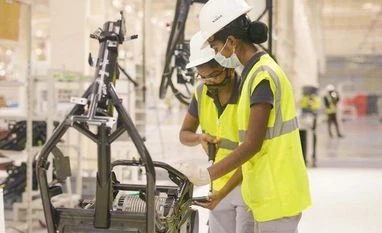 "India's gender empowerment enigma")












 Connect with us on WhatsApp